
Caught between HTS rule and western hypocrisy, Syria’s Christian communities are being quietly erased from their ancestral homeland – while officials promote false images of coexistence.

The Cradle's Syria Correspondent

For decades, the Christian minority found uneasy protection under former Syrian president Bashar al-Assad’s staunch, though secular, rule. But after 14 years of war and the more recent ascendance of Hayat Tahrir al-Sham (HTS) and its leader, self-appointed Syrian president Ahmad al-Sharaa (formerly known as Abu Mohammad al-Julani), that fragile security has shattered.
When a small group of Syrian Christians in Australia recently invited fellow Christians to apply for asylum, they were stunned by the response: 15,000 requests arrived within the first day.
The flood of applications revealed the depth of despair among Christians still living in Syria. They once made up nearly 10 percent of the population, but their numbers are dwindling fast.
The Syrian war left deep and lasting scars on Christian communities. Entire neighborhoods in cities such as Aleppo, Homs, and Damascus have been emptied, with churches damaged or destroyed and families forced to flee.
Thousands of Christians were killed, kidnapped, or displaced during the height of the conflict. The trauma of war itself was the first push toward emigration, a wound that continues to grow as communities shrink each year.
Promise and persecution
After Assad’s fall in December 2024, HTS attempted to reinvent itself. Its leader, former Al-Qaeda leader-turned-president Sharaa, who at the time went by the nom de guerre Abu Mohammad al-Julani, issued promises to protect religious minorities. But those pledges faded almost immediately.
With HTS’s history of extremism and intolerance, the group’s rise to power revived old fears. Even without new waves of violence, HTS’s rule has left Christians anxious about their future, forcing them to live in a constant state of uncertainty.
On the ground, those promises faded quickly. Pressure on Christians started right away. Before Christmas in 2024, HTS leaders met with priests in Damascus and told them to ask their people to dress more conservatively during the holiday.
At the same time, HTS media teams went around filming in churches, showing pictures of Christians smiling and celebrating, to send a message to the outside world that “Christians are happy in the new Syria.”
Despite this, Christians in the capital staged a protest over the burning of a public Christmas tree in the central governorate of Hama, reportedly carried out by militants affiliated with HTS.
As time passed, government security forces loyal to Sharaa carried out massacres in the coastal cities against Alawite communities. At least 1,600 Alawite civilians were killed in just three days.
Christians began to hear the chilling warning that they would be next to face slaughter.
Mazen, a Christian from Damascus, recalls to The Cradle one incident during Ramadan, the Muslim holy month of fasting.
“I was smoking in my car when a soldier from the security forces came to me. He asked why I was smoking in Ramadan. I told him I was Christian. He grabbed the cigarette from my hand and said, ‘Christians, your time will soon come.’”
This phrase spread, both on social media and through direct threats from soldiers belonging to Syria’s security forces.
While most of HTS’s promises of protection quickly faded, the promise that “your time will come” did prove true.
In June, a suicide bomber entered the Mar Elias Church in Damascus during Sunday mass. The bomber killed 25 worshipers and injured 70 more. The Syrian government quickly blamed the bombing on ISIS, but it later emerged that he was a member of President Sharaa’s security forces – the General Security.
For Christians, it marked a grim turning point.
In July, a new round of massacres carried out by Sharaa’s security forces in the Druze-majority governorate of Suwayda added another layer of fear for Christians across Syria.
Local tribes, acting in support of government forces, not only massacred hundreds of Druze civilians, but also targeted Suwayda’s Christians, burning six churches and murdering an evangelical pastor, Khaled Mazher, along with his entire family – 13 people, including women and children.
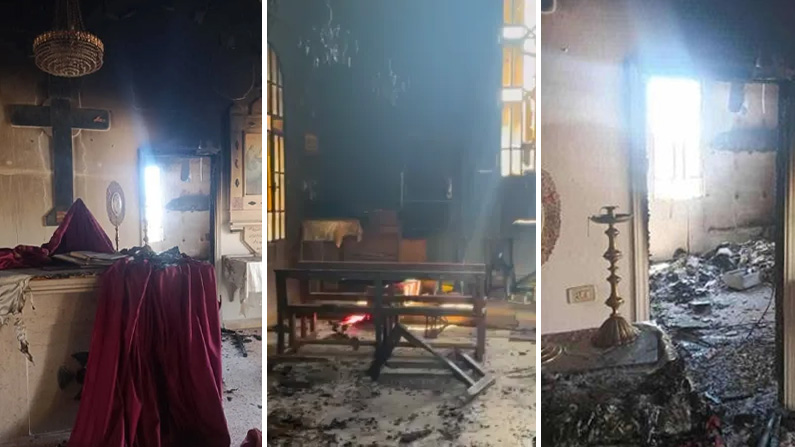
Some of the fighters dispatched by Syria’s leadership to massacre the Druze and Christians in Suwayda proudly wore black ISIS patches.
The thin line between ISIS and Julani’s security forces was again revealed just days ago, on 14 December, when ISIS gunmen carried out an attack on a US troop convoy in Palmyra in eastern Syria, killing two US soldiers and one civilian interpreter.
Like in the Mar Elias church bombing in July, it was soon revealed that the attacker was an ISIS member who had joined Syria’s security forces. The Ministry of Defense acknowledged they had been aware of his extremist beliefs, and claimed they had planned to dismiss him but were delayed because of the “weekend.”
The attack will benefit the US, which has a pretext to further occupy Syria, and Sharaa, who will be touted in Washington as a needed “counter-terror” partner.
Terror at the threshold
But for Christians in Syria, the belief that the western nations would protect them, whether from Sharaa or from ISIS, is fading.
More people in the community are starting to feel that western nations only claim to care about Syria’s Christians and the crimes committed against them to maintain leverage against the new government in Damascus.
This belief was underscored by two additional recent events. On 5 December 2025, ahead of the celebrations marking the fall of Assad, Christians gathered at the Mar Elias Church to reclaim hope for their lives after the tragic incident in July. The gathering took place during a Christmas tree lighting event named the “Tree of Peace.”
During the event, two unidentified individuals moved through the crowd carrying black flags, causing panic among attendees. People fled the area rapidly, as peace turned to terror.
One woman commented, “God will never forgive those who terrified us. We will never forget what happened.” Media outlets remained silent about the incident, despite residents living in a state of indescribable fear.
Ten days later, in the Adawiya neighborhood of Homs, residents woke to find their Christmas tree torched. No culprits were named. No arrests made.
One resident commented, “The propaganda and the attempts to appease European countries and the United States are over. The extremists can no longer tolerate it. We place our fate in God’s hands.”
Coercion without headlines
While violent attacks grab headlines, subtler pressures are reshaping Christian life in Syria just as profoundly. These quieter forms of intimidation reveal how communities are being isolated and marginalized without large-scale violence.
Even when there are no large-scale, organized attacks on Christian villages or neighborhoods, subtle threats and acts of intimidation are enough to shake and devastate a peaceful community like the Christians.
One example of this occurred in January when a group of Muslim proselytizers drove their car through Al-Qassaa, a Christian neighborhood in Damascus. They patrolled the streets, calling on Christians to convert to Islam and handing out flyers promoting the wearing of the hijab.
What might seem like a simple act quickly turned tense, sparking a clash with young men from the neighborhood. For many Christians, the incident was a reminder that their faith and presence could be openly challenged, even in their own neighborhoods.
Beyond public confrontations, Christians also face harassment in their workplaces. Samia, a Christian engineer who had worked with the government for 30 years, tells The Cradle how she was repeatedly harassed by the new authorities and pressured until she was finally forced to resign.
Her experience is not unique; many other Christians in Syria have faced the same kind of sectarian discrimination and intimidation in their workplaces, with the explicit aim of pushing them out of their positions.
In some areas, even schools are not safe for Christians.
Danny, a 16-year-old student, became a target at his own school. His sister informs The Cradle that in April, security forces guarding the school kidnapped him after discovering he was Christian.
They stopped him at the school's entrance and told him, “This is an Islamic area – you must convert to Islam, or we will have you beheaded.”
Danny refused, standing firm despite the threat. His family begged for his release, and eventually, with the intervention of respected Christian figures in the community, he was freed.
The incident left deep scars, showing how even young students are not spared from intimidation and sectarian pressure.
Even worse, the wave of kidnappings of minorities that marked the 14-year war on Syria has made a comeback. It has become widely known among extremist factions in Syria’s new army that Christians are easy targets for kidnapping.
The belief is simple: Christians will pay any ransom, no matter the amount demanded. This has turned kidnappings into a dangerous business, leaving Christian families in constant fear for their loved ones.
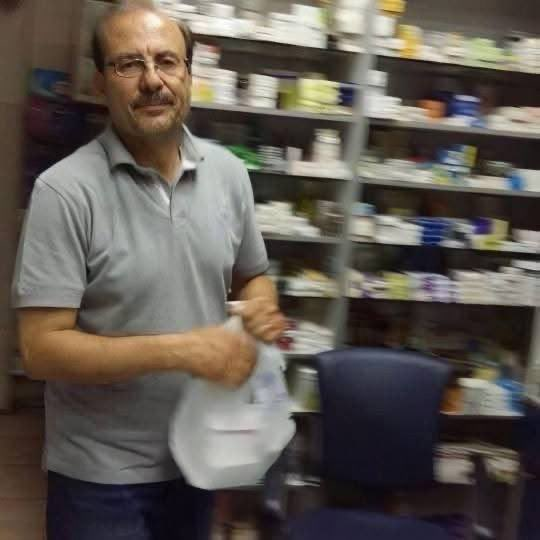
On 2 July, for example, a well-known and respected pharmacist, Jean Dodosh, was kidnapped in front of his home in the Christian neighborhood of Al-Tijara in Damascus. He was held for more than 15 days and only released after his family was forced to pay a massive ransom. The exact sum remains undisclosed.
Legitimacy by manipulation
In August, Orthodox Patriarch Yaziji visited Sharaa at the presidential palace. The visit shocked many in the Christian community. Just two months earlier, Yaziji had publicly condemned the government over the Mar Elias bombing. What changed?
For many, the answer lies in international optics. The visit was widely seen as an effort, coordinated by HTS’s foreign backers, to salvage Sharaa’s image after the Suwayda massacres. Christians were again deployed as symbolic proof of “tolerance” in a deeply intolerant state.
This is not without precedent.
When ISIS stormed Mosul in 2014, Christians were given a grim ultimatum: convert, pay a form of tax levied on certain non-Muslim subjects known as ‘jizya,’ or die.
Two months later, ISIS attacked the historic Christian villages in the Nineveh Plains – and the defenseless inhabitants were abandoned by Kurdish Peshmerga forces that had promised to protect them.
The entire Christian population had no choice but to flee in the middle of the night as ISIS militants descended on their ancient homeland.
Crosses were torn down, churches burned, and homes marked with the Arabic letter “ن” (N for Nasrani, meaning Christian) to identify their owners for confiscation.
Over 120,000 Christians fled from Mosul and the Nineveh Plains, seeking refuge in the Kurdistan region or abroad. Today, Mosul, once home to a vibrant Christian community, stands almost empty of its original inhabitants.
No future here
As Ahmad al-Sharaa consolidates growing political and military backing in Syria, many Christians fear that history is repeating itself – this time through softer, less visible means – and are increasingly questioning whether there is a deliberate effort to hollow out West Asia of its Christian communities.
Speaking to The Cradle, Tony, a Christian from Damascus, says: “For the US, EU, and UN, Julani gives you political speech saying that minorities are welcome and will be protected, but on the ground, his supporters and army do the opposite.”
He cites a saying in Arabic, “When I hear your speech, I believe you. But when I see your actions, I am shocked.”
As a result, many Syrian Christians speaking with The Cradle say they urgently need to leave the country, as they no longer feel they belong to this land, leaving a once-peaceful community feeling even more devastated and depressed.
Those who depart carry with them the enduring spirit of their homeland, taking its soul wherever they go in search of a safer, better life.
At the same time, others are determined to stay, despite the fear and danger.
“They want to cleanse Syria of Christians. There is no hope for the future for us. But I am not here to live, I am here to stay. There is a difference,” Tony explains.
“If I leave, maybe I could get married, or start a business. But I refuse to leave because this is my land. Even if you want to kill me, I will stay. I am here. Jesus says don’t fear those who kill the body, because the soul they can’t kill. If I really believe in Jesus 100 percent, I have to believe in his word. I choose to believe. So, according to my belief, I am going to stay.”
The cost of silence
Behind the language of security and reform, Syria’s ancient Christian presence is being slowly dismantled.
This erasure is not the result of a single act of violence but the outcome of years of systematic coercion, silence, and abandonment. Churches are targeted as those tasked with protection look away – or enable it.
Patriarchs once vocal in their condemnation now share stages with the very figures they once denounced. Western officials issue periodic statements of concern, while HTS leadership curates images of religious harmony for external consumption, masking the deepening repression faced by Christians on the ground.
Those who remain carry the memory of a community that helped shape Syria’s cities, culture, and history. Every act of staying is a quiet defiance against both the violence of their rulers and the indifference of foreign powers who posture as protectors.

No comments:
Post a Comment