
By Palestine Chronicle Editors
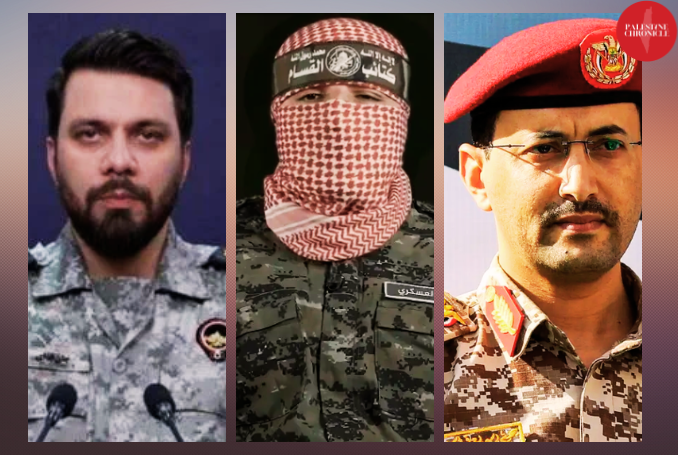 Ibrahim Zolfaghari, Abu Obeida, and Yahya Saree. (Photos: video grab. Design: Palestine Chronicle)
From Gaza to Yemen to Iran, military spokesmen have emerged as central figures in a transformed, unified battlefield.
The current phase of war in the Middle East has not only redrawn military maps—it has redefined how war itself is articulated, perceived, and embodied.
What was once described as the “unity of squares – has evolved into something far more concrete: a ‘unity of battlefields’.
Overlapping conflicts have driven this transformation—the ongoing genocide in Gaza, the widening regional confrontations, and most decisively, the US-Israeli aggression on Iran beginning February 28.
The result is not merely coordination. It is simultaneity: Missiles launched from Yemen align with operations in Lebanon. Statements issued in Tehran echo those emerging from Gaza. Military timelines intersect, narratives converge, and the war begins to function as a single, interconnected space.
This shift—from conceptual alignment to tangible, synchronized warfare—has also produced a parallel transformation: the emergence of new kinds of figures who represent this war.
People’s Voices
One layer of this transformation is rooted in the visibility of ordinary people.
Across Gaza, Yemen, Lebanon, and Iran, men, women, and children have produced some of the most powerful and widely circulated narratives of the war. Their testimonies—often recorded in real time—have reshaped how events are understood, bypassing traditional media structures.
These voices have become iconic in their own right. They reassert a fundamental principle: that history is not only written by institutions or states, but also articulated by people themselves.
Through social media, these individuals have turned lived experience into political discourse, often reaching audiences far beyond their immediate surroundings.
But while these voices are central, they exist alongside another, more structured phenomenon.
The Spokesman
At the forefront of this second layer stand military spokesmen.
Figures such as Abu Obeida in Gaza, Ibrahim Zolfaghari in Iran, and Yahya Saree of Ansarallah in Yemen have moved far beyond their formal roles as conveyors of information.
They do not simply announce operations. They embody them.
Each appearance is not just a briefing—it is an event. Each statement is not merely descriptive—it is performative, strategic, and deeply embedded in the broader logic of the war.
Their tone, language, timing, and even physical presence form part of the battlefield itself.
When Abu Obeida declared that “the shortest way to liberate the prisoners is through resistance,” he was not simply making a tactical argument, but reaffirming a long-standing doctrine that places armed struggle at the center of political outcomes.
When Yahya Saree repeatedly emphasized that operations “will continue”, he was not merely describing military continuity, but situating Yemen within an expanding, unified confrontation that stretches beyond its borders.
And when Ibrahim Zolfaghari addressed US forces directly, warning that they could become “food for the sharks of the Persian Gulf,” he was projecting a language of deterrence that bypasses mediation and speaks directly to adversaries in their own political and psychological space.
Each of these statements operates beyond information. It is a signal.
Iconic Presence
What distinguishes these figures is not only what they say, but how they are received.
Abu Obeida, the military spokesman of Al-Qassam Brigades, has become one of the most recognizable figures associated with the Palestinian resistance. His carefully structured statements, delivered with consistency and clarity, resonate far beyond Gaza.
Yahya Saree, speaking on behalf of Yemen’s Ansarallah, has similarly established a steady presence, announcing operations that are explicitly framed within a broader regional alignment.
In Iran, Ibrahim Zolfaghari has introduced a different dimension—multilingual communication that directly addresses multiple audiences, including Israeli society itself, collapsing linguistic distance and reinforcing psychological impact.
Their words travel instantly. Their tone is studied. Their pauses, repetitions, and formulations become recognizable patterns.
They are quoted, clipped, translated, and redistributed across platforms.
Their presence generates expectation.
Their absence raises questions.
Beyond Individual
Perhaps the most striking aspect of this phenomenon is that it does not depend on the individual alone.
Following the assassination of Abu Obeida, a new figure emerged under the same name—continuing the role with remarkable continuity in tone, cadence, and presence. The transition was seamless.
Nothing essential changed. This continuity suggests that Abu Obeida is no longer merely a person. He is a constructed presence, sustained by a broader institutional and cultural framework.
A voice that can be reproduced. A figure that can be reinhabited. The same applies, in different ways, to Saree and Zolfaghari. They function not only as individuals, but as expressions of a collective identity.
Language as Power
Central to this transformation is the role of language. These spokesmen do not simply communicate facts. They structure meaning.
Abu Obeida consistently frames resistance as the decisive factor in shaping outcomes, linking battlefield action to political consequence.
Saree situates Yemeni operations within a wider geography of solidarity, where each strike is part of a broader moral and strategic framework.
Zolfaghari, in turn, employs direct, often multilingual messaging that collapses the distance between speaker and audience, reinforcing the immediacy of the confrontation.
Language, in this context, becomes a form of action. It shapes perception, influences morale, and contributes to the overall conduct of the war.
The New Role
The evolution of these figures reflects a broader shift in the role of the military spokesman.
Traditionally, the spokesman was a mediator—someone who translated battlefield developments into public information. Today, that role has expanded significantly.
The spokesman is now a strategic actor.
His presence carries weight beyond the content of his statements. His credibility, tone, and consistency contribute to shaping how the war is understood, both regionally and globally.
A Collective Symbol
Ultimately, the significance of figures like Abu Obeida, Zolfaghari, and Saree lies in what they represent. They are not isolated personalities. They are part of a wider phenomenon that reflects the convergence of battlefields, narratives, and public perception.
In a moment defined by fragmentation, they provide continuity. In a landscape shaped by competing narratives, they offer a consistent voice.
And in a war that spans multiple fronts, they embody the idea that those fronts are no longer separate.
They are one.
(The Palestine Chronicle)

No comments:
Post a Comment