
By Palestine Chronicle Editors
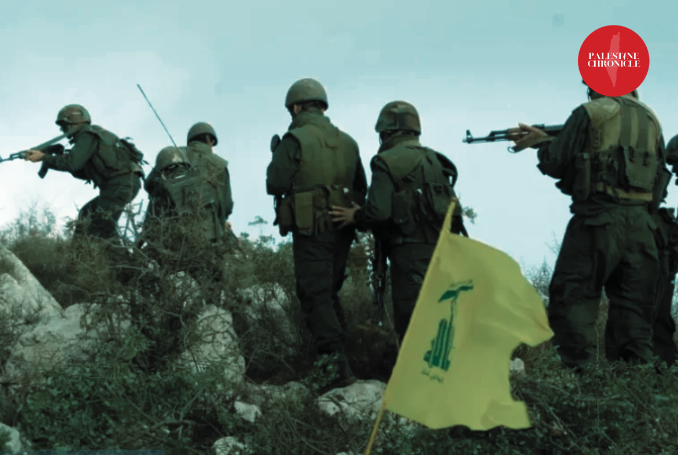 Hezbollah fighters in South Lebanon. (Photo: Military Media, via Al Mayadeen)
Iran’s largest wave signals rising confidence, deeper coordination, and a shift toward sustained, multi-front regional confrontation.
Escalation Redefined
The latest Iranian military wave marks more than a quantitative escalation—it reflects a transformation in the nature of the war itself.
Israeli media reported that the most recent Iranian attack is the largest since the beginning of the war, with direct impacts recorded in central areas, including Ramat Gan and Petah Tikva, where a building collapsed following a direct strike. Additional reports confirmed Israeli vehicles igniting and widespread structural damage across multiple sites.
Yet the significance of this wave lies not only in its scale, but in what it represents: a shift from reactive engagement to sustained, deliberate escalation.
The 89th wave of Operation True Promise 4 unfolded across an expansive geography, with more than 300 missiles and drones launched in coordinated formations. Over 100 heavy missiles, alongside hundreds of drones, struck targets across Tel Aviv, Bnei Brak, Eilat, and other locations, extending across tens of thousands of kilometers.
This was not an isolated surge. It is the continuation of a pattern that has remained consistent despite months of sustained bombardment on Iran itself.
Unified Frontlines
What distinguishes the current phase is the clarity of coordination across multiple fronts.
Iranian operations are now unfolding simultaneously with Hezbollah actions in southern Lebanon and Ansarallah operations in Yemen, forming a synchronized regional front that is more visible than at any previous stage.
In Lebanon, Hezbollah confirmed rocket strikes targeting newly established Israeli artillery positions in Rab Thalathin and troop concentrations in Odaisseh. These operations coincided directly with Iranian missile waves, reinforcing the operational unity between fronts.
Iran has explicitly defined these actions as coordinated and integrated operations carried out by Iranian forces alongside resistance movements across the region.
The scale of coordination is not limited to timing. It reflects an alignment of objectives, messaging, and battlefield strategy.
Operations have been dedicated to fighters across these fronts, including those in Yemen, underscoring the interconnected nature of the campaign.
Ansarallah’s continued missile operations toward Israeli-linked targets further expand this coordinated framework, placing pressure across multiple geographic axes simultaneously.
The fragmentation that once characterized regional responses has been replaced by cohesion.
Steady Firepower
The sustained pace of Iranian strikes continues to challenge claims that its capabilities have been significantly reduced.
Since February 28, Iran has launched approximately 6,770 missiles and drones across the region, targeting Israel and multiple Gulf states, including the United Arab Emirates, Kuwait, Qatar, and Saudi Arabia.
The pattern remains consistent. Over the past week alone, Iran launched around 200 missiles and more than 200 drones toward Israeli targets, maintaining a steady operational rhythm.
There has been no visible decline in frequency or scale.
Beyond volume, Iran has expanded the scope of its targeting. Recent operations included drone strikes on strategic technological facilities, including sites linked to Siemens near Ben Gurion Airport and a research center associated with AT&T in Haifa.
These targets reflect a deliberate focus on infrastructure connected to military production and communications.
Simultaneously, Iranian operations have extended beyond Israeli territory, targeting radar and electronic warfare systems in the UAE using long-range Arash-2 drones.
The battlefield is no longer confined. It has become regional in both scope and design.
Expanding Battlespace
Iran’s operations now openly include US-linked targets across the region, further widening the confrontation.
Ballistic missiles struck positions associated with US forces, including a helicopter group at Al Udeid Air Base. Additional strikes targeted what was described as a US military shelter in Bahrain.
These operations indicate a direct engagement with US military infrastructure, moving beyond indirect confrontation.
The geographical expansion of the conflict—from Israel to the Gulf, from Lebanon to Yemen—demonstrates a shift toward a comprehensive regional battlespace.
Each front is no longer operating in isolation. They function as interconnected components of a broader campaign.
Assertive Language
Parallel to the military escalation is a noticeable shift in Iran’s political and military discourse.
Iranian officials now speak with a level of confidence that reflects their assessment of the battlefield.
General Ali Jahanshahi, commander of Iran’s Ground Forces, addressed US soldiers directly, warning that their families should contact them within 24 hours, adding: “We will see what happens.”
This language marks a departure from earlier phases of the conflict, where messaging was more restrained and reactive.
Statements now emphasize Iran’s position as a decisive force shaping regional equations, highlighting the unity of fronts and the cohesion of allied movements as central achievements.
Iranian officials have framed the current phase as one of transformation, pointing to coordinated operations and sustained resistance as indicators of a shifting balance of power.
Strategic Persistence
The persistence of Iranian operations, despite extensive US and Israeli strikes, reinforces the trajectory of the conflict toward a prolonged phase.
US figures indicate that more than 11,000 targets have been struck in Iran, while Israeli forces have conducted hundreds of airstrike waves involving thousands of munitions.
These operations have targeted military infrastructure, production facilities, and command centers.
Yet Iran’s ability to sustain large-scale, coordinated attacks across multiple fronts remains unchanged.
The continuity of operations suggests that the conflict is not approaching resolution, but rather entering a new phase defined by endurance.
Iranian statements emphasize readiness to continue operations over an extended period, supported by what officials describe as strong internal cohesion and regional alliances.
Prolonged Trajectory
The latest escalation is not a singular event. It is a reflection of a broader transformation in both the conduct and the discourse of the war.
Iran’s largest wave since the start of the conflict signals more than increased firepower. It reflects a consolidated regional alignment, a steady operational capacity, and a growing confidence in shaping the trajectory of the confrontation.
Simultaneous operations across Israel, Lebanon, Yemen, and the Gulf illustrate a battlefield that has expanded beyond traditional boundaries.
The language accompanying these operations—direct, assertive, and forward-looking—mirrors this shift.
As the United States weighs its options between escalation and recalibration, Iran and its allies continue to operate within a framework that prioritizes continuity and coordination.
The war, as it now stands, is defined not only by strikes and counterstrikes, but by an evolving structure of regional engagement that shows no immediate signs of contraction.
(The Palestine Chronicle)

No comments:
Post a Comment