
By Palestine Chronicle Staff
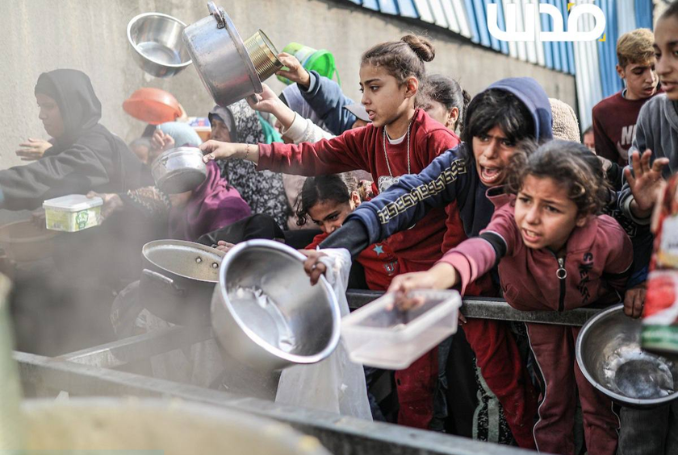 The United Nations declared the state of man-made famine in Gaza. (Photo: via QNN)
UN experts report that while formal famine has ended, 100,000 Gazans remain in catastrophic conditions amid a brutal, flooded winter.
While international food monitors have officially lifted the “famine” designation for the Gaza Strip, the humanitarian reality remains a profound “failure of humanity.”
According to the latest UN-backed Integrated Food Security Phase Classification (IPC) report, approximately 100,000 Palestinians continue to endure “catastrophic conditions,” the highest level of food insecurity.
The report indicates that while nutrition has improved since the October ceasefire, the situation remains “highly fragile.” Nearly one in eight people still face severe food shortages, and 1.6 million are expected to face “crisis” levels of hunger through the spring.
The technical shift in classification offers little relief to families currently battling a harsh winter. The IPC noted that “living conditions in the Gaza Strip are still catastrophic, made worse by the winter weather.” Most displaced Gazans live in frayed tents that offer no protection against torrential rains.
Medical officials have highlighted the lethal nature of these conditions. Recently, a 29-day-old baby died of hypothermia in Nasser Hospital—a tragedy health workers say was entirely preventable if basic survival items like blankets and heating were available.
The IPC warns that Gaza’s food security is entirely dependent on the current, fragile ceasefire. It stressed that “if there were renewed hostilities, the entire Strip would be at risk of famine,” underscoring how thin the margin for survival has become.
The destruction of Gaza’s self-sufficiency is nearly total. The IPC analysis found that “more than 96% of crop land in Gaza (is) destroyed or inaccessible,” leaving the population almost exclusively dependent on external aid.
While the Israeli military body COGAT claims aid levels are sufficient, humanitarian groups like Oxfam report a different story. Millions of dollars in food parcels and winter supplies remain stalled at the border, blocked by Israeli authorities.
Despite the eased restrictions, the UN warns that the current aid delivery is inconsistent. The IPC stated that the crisis is driven by “restricted humanitarian access, displacement… and the destruction of livelihoods.”
This current “emergency” is not an accidental disaster but the direct result of what many international legal experts and human rights organizations have termed a systematic campaign of genocide. The famine that peaked in August 2024 was triggered by a total blockade of aid, which UN officials described as a “systematic obstruction” by Israel used as a weapon of war.
For two years, the intentional starvation of the population served as a core component of the Israeli genocide in Gaza, claiming the lives of hundreds of Palestinians due to malnutrition alone.
While aid flows have marginally increased under international pressure, the underlying structures of the siege remain. The IPC’s warning that famine could return instantly highlights the reality that as long as the military occupation and blockade persist, the Palestinian people remain trapped in a manufactured cycle of survival and death.
(PC, Guardian, BBC, AJA)

No comments:
Post a Comment