
Behind Israel’s military push in southern Syria lies an effort to command the region’s lifelines – its water and gas – and with them, its future influence.

The Cradle

From this vantage, Israel can monitor air activity stretching from Gibraltar to Syria, a capability enhanced by advanced surveillance systems.
In Quneitra Governorate, Israel has entrenched itself across nearly the entire area, establishing multiple checkpoints and fortified positions. Its forces have even advanced into the Damascus countryside, reaching as far as the dissolved 78th Brigade – just five kilometres from Qatna and 20 from central Damascus.
Israeli positions now extend to Rakhla, opposite the Lebanese town of Yahmar. Rakhla is a strategic point that rises 1,500 meters and overlooks three vital roads linking Damascus to Baalbek and Beirut, as well as overlooking the Lebanese Bekaa Valley, and is about 30 kilometers from the Masnaa crossing – the main road between Damascus and Beirut.
Further east, Suwayda province has effectively slipped from Damascus’s authority. Following Israel’s declared “protection” of the Druze community – reiterated by Israeli Prime Minister Benjamin Netanyahu and other officials – local factions have formed a 3,000-strong “National Guard” under unified command, reportedly funded directly by Israel, according to Reuters.
While these territorial gains are often discussed through a security lens, their implications go far beyond the battlefield. Israel’s control over geography is increasingly intertwined with control over resources – particularly water and gas – two commodities that define power and survival in the Levant.
Water and gas as instruments of power
Tel Aviv’s recent advances have turned southern Syria into a theater where resource competition is reshaping regional politics. Beyond military encroachment, Israel’s ambition lies in dominating the Yarmouk Basin – an essential water reservoir feeding Syria, Jordan, and occupied Palestine.
Its integration into Israel’s existing water grid, stretching from the Galilee to the desert, would mark a significant expansion of Israeli hydro-hegemony.
Yet water is only part of the story. Southern Syria also sits at the crossroads of energy ambitions. Israel seeks to obstruct any future route of the long-proposed Qatari–Turkish gas pipeline that would pass through Syria on its way to Europe – an alternative that could undermine Israel’s EastMed gas export corridor.
In this sense, southern Syria is turning into a point of contact between the water and gas projects, as Tel Aviv seeks to monopolize suppliers as geostrategic leverage that gives it the ability to remap energy and sovereignty in the Levant.
The Qatari–Turkish pipeline and Israel’s counter-moves
The Qatari–Turkish gas pipeline – originally conceived in 2009 – was meant to carry Qatari gas through Saudi Arabia, Jordan, and Syria to Turkiye and onward to Europe. Damascus rejected it then, siding with Moscow’s competing interests.
But with the EU planning to end its dependence on Russian gas by 2027, the idea has regained traction – especially after the collapse of Syria’s central government.
On 9 December 2024, a day after the fall of Damascus, Turkish Energy Minister Alp Arslan Bayraktar publicly suggested the project could be revived “if Syria achieves its (territorial) integrity and stability.” He added, “If so, this pipeline must be safe. We hope so. If so, there are many projects waiting to be implemented.”
Israel, though not a participant in the pipeline, is watching closely. Over the past decade, it has positioned itself as an energy exporter to Europe, with the Leviathan and Tamar gas fields at the core of its strategy. Through the EastMed pipeline to Cyprus and Greece, and exports to Egypt for liquefaction and re-export, Israel has built an energy architecture designed to cement its regional role.
Analyses from Israeli think tanks, including the Begin–Sadat Center for Strategic Studies, warn that a Qatari–Turkish pipeline would directly compete with Israel’s projects by offering Europe cheaper gas. Turning Turkiye into the main energy gateway would also undermine Tel Aviv’s ambition to serve as the region’s principal hub.
Some Israeli researchers concede that while linking Turkiye to the Arab Gas Pipeline through Egypt and Jordan could benefit Israeli exports, a revived Qatari route would severely diminish Israel’s leverage.
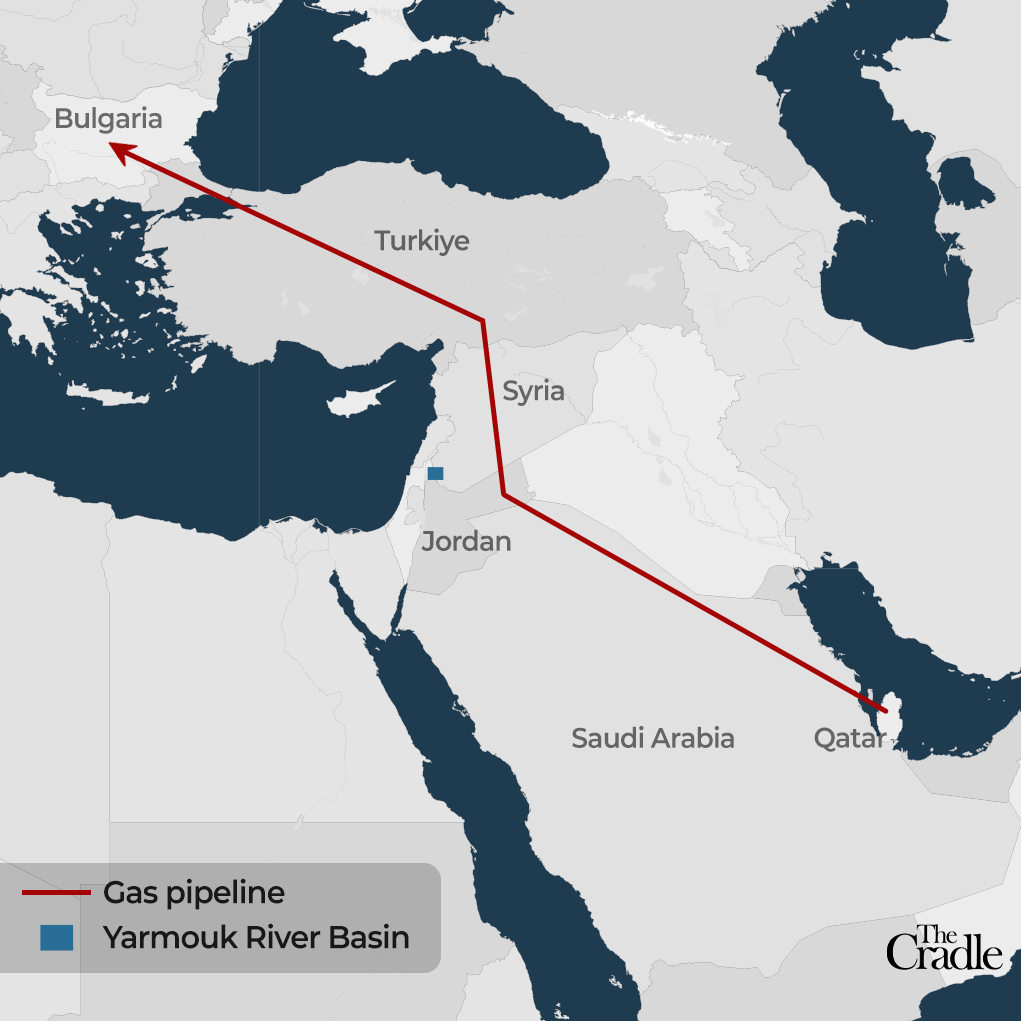
Southern Syria: The new energy corridor
Economist Amer Deeb, head of the Syrian Renaissance Council, tells The Cradle that the renewed conflict in the south cannot be separated from these resource equations. Security and economy now move along the same axis, he says, describing the region stretching from Deraa and Suwayda to Quneitra and the occupied Golan as the most sensitive zone for energy, agriculture, and water.
Deeb points out that Israel's discovery of the Leviathan field marked a turning point in the status of Israel, which, since 2024, has exported more than 13.1 billion cubic meters of gas to Egypt and Jordan, and seeks to expand its production to become a direct competitor to Qatari or Iranian gas projects.
Any revival of the Qatari–Turkish line, Deeb explains, would upend existing energy dynamics, noting that it would shift the balance of influence toward Doha and Ankara and directly threaten Israeli exports.
The battle for water supremacy
Parallel to its energy ambitions, Israel has intensified control over southern Syria’s water network, focusing on the Yarmouk River Basin and the Wahda Dam on the Syrian–Jordanian border. This basin sustains much of southern Syria and northern Jordan, providing roughly a tenth of their water needs.
This control is part of a broader plan that includes Jabal al-Sheikh, the Baniyas spring, and dams in Quneitra, where Tel Aviv has expanded over the past months to smaller dams such as Al-Mantara (that covers about two percent of the region's irrigation), Ein al-Ziwan (1.5 percent), and the headwaters of the Raqqad River, which constitutes about eight percent of the south's water resources.
By controlling the Yarmouk River, which covers about 20 percent of the southern water supply, Israel is able to influence the reservoir of the Wahda Dam (with a capacity of 110 million square meters), on which the governorates of southern Syria and northern Jordan depend for about 10 percent of their water needs.
In a recent development, Israeli forces have moved toward the Jubailiya Dam in the western countryside of Deraa (which covers about three percent of local irrigation).
These shifts threaten Jordan with the loss of a strategic water resource and turn southern Syria into an arena of regional influence controlled by Israel through water, not just military power.
Speaking to The Cradle, political analyst Jaafar Khaddour explains:
"Israeli control over southern Syria comes in strategic estimation, not only from the security aspect, but also from the social and energy resources aspect. Israeli policy in southern Syria has begun to take on a new dimension that is not limited to incursions, as the month of September 2025 witnessed the destruction of water lines in the villages of Zubaydah al-Sharqiyah in the central countryside of Quneitra and Al-Hamidiyah in the northern countryside of Quneitra, which led to the cutting off of water to the local population."
He adds that “It is a prelude to pressure the population and possibly their displacement later,” stressing that “settlement is based on substitution and abolition, that is, bringing settlers to replace the indigenous population, and it relies for many of its resources on water, especially agricultural settlements, of which water is the main artery.”
A report by Israel’s Knowledge Center for Climate Change Preparedness argued that future security escalations in Syria are inevitable and even “necessary,” citing projections that Syria’s population will grow by 60 percent by 2050 amid severe drought. Such conditions, the report claimed, justify Israel’s pre-emptive control of water as a strategic buffer and negotiation tool.
Water, agriculture, and demographic control
Deeb notes that the Golan Basin alone supplies more than 30 percent of Israel’s agricultural water. This means any expansion into southern Syria ensures long-term water supremacy in an already resource-starved region. The fertile stretch from Quneitra to Deraa, he adds, is being eyed for Israeli-backed agricultural projects positioned for export to nearby markets in Jordan and Israel.
The area is directly linked to the Yarmouk and Golan water networks, which are historically some of the most important sources of water in the Levant, he explains, and includes fertile agricultural lands that have played a major role in Syrian agricultural production.
The importance of the south is no longer limited to agriculture; it has become geo-energy, as the area constitutes a potential land corridor for any gas or oil pipeline connecting the Persian Gulf to the Mediterranean Sea or Turkiye, making its control a common goal for regional actors.
Khaddour elaborates further:
“The strategic security origin of Israel's settlement policy gives Tel Aviv the upper hand to provide blackmail cards in any negotiations, as Jordan, for example, buys water from the Zionist entity, and since 1967, Israel has taken more than 80 million cubic meters of Syrian water, and the total amount it extracts from the surrounding countries is more than 1,280 million cubic meters annually.”
“All these delicate and dangerous details make the energy file a security and political title in the Israeli strategy, as it is not only about water resources as natural resources, but also as a tool for control and domination, especially in a dry and desert region like ours,” Khaddour adds.
Resource wars and the future of the south
Southern Syria’s conflict has evolved far beyond traditional warfare. It now represents a multidimensional struggle over geography, sovereignty, and survival. Water and gas – once natural resources – have become the linchpins of Israel’s regional strategy.
Amid worsening climate conditions, Israel is turning its environmental vulnerabilities into geopolitical assets. By controlling key basins and blocking rival pipelines, it is transforming scarcity into leverage. For Syria’s transitional authorities, the challenge is existential: to defend what remains of the nation’s strategic lifelines under conditions of economic collapse and foreign encroachment.
The outcome of this contest will determine more than the fate of southern Syria. It will shape the next chapter of West Asia’s balance of power – one defined not by frontlines, but by who controls the flow of water and energy across the region’s fractured map.
Beyond Syria, Israel’s strategy of resource-based leverage extends deep into the Persian Gulf. Through firms like IDE Technologies, Tel Aviv has embedded its desalination and water-recycling systems at the core of Saudi and Kuwaiti infrastructure, often via consortia that conceal Israeli participation behind European intermediaries. Israeli hydrogeology experts recommend that Tel Aviv cooperate with Damascus in managing water resources after the fall of Assad’s government, highlighting Israel’s strategic control over groundwater development and agricultural projects. This approach could give Israel significant influence over water management in Syria, particularly regarding the Eastern Hermon Aquifer, which feeds the Baniyas and Dan Rivers and Wadi Barada – the main water source for Damascus. This has evolved into a regional model of influence, where dependence on Israeli water technology quietly advances normalization without diplomacy or declarations.

No comments:
Post a Comment