
By Alain Alameddine
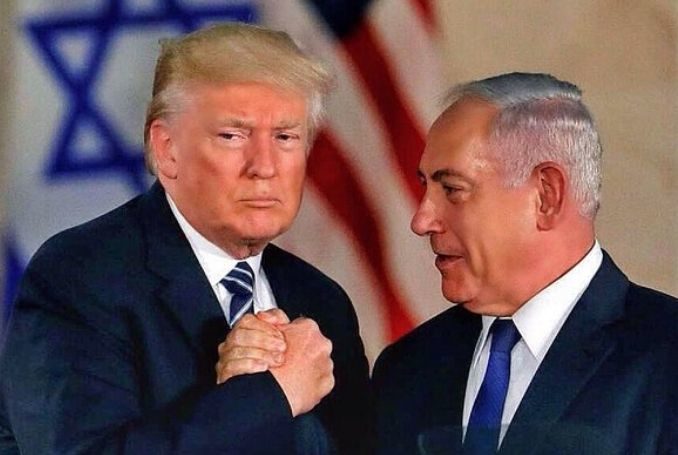 US President Donald Trump (L) with Israeli Prime Minister Benjamin Netanyahu. (Photo: File)
Trump’s plan demands the total capitulation of Palestinians – the concession of Palestinian sovereignty and resistance. This colonial attack must be confronted by all Palestinians, irrespective of their affiliations, in order to protect the Palestinian cause.
Trump’s plan is not a proposal for a ceasefire, or even for a defeat that the Palestinians can manage and eventually recover from, but rather for total capitulation. It also targets not only Hamas, but the entire Palestinian society. Of course, no one has the right to silence the Palestinian voice in Gaza and the diverse, supporting, opposing, and hesitant opinions there regarding the plan. At the same time, it is necessary to analyze its content and take action for Gaza and Palestine. In addition to not guaranteeing an end to the genocide, how does Trump’s plan form the basis for liquidating the Palestinian cause? And how can we influence the balance of power in the face of this colonial attack?
A Plan That Concedes Two Fundamental Rights: Resistance and Sovereignty
The plan does not only stipulate that Hamas must give up its weapons. It also speaks of a commitment and pledge by all factions that Gaza will not pose a threat to the colony, and speaks of Gaza as a “de-radicalized terror-free zone”, which implies recognizing the resistance as radicalism and terrorism. It also speaks of “amnesty” for fighters who drop the armed resistance, which implies recognizing resistance as a crime.
Furthermore, the plan does not only stipulate Hamas’ commitment not to play any role in governing Gaza. It also proposes a temporary transitional government run by a committee of Palestinians and non-Palestinians, without specifying the duration of this transition, the number or percentage of Palestinians in it, the citizenship of the non-Palestinians, or how its members will be selected. This committee would be under the supervision of an international transitional body headed by Trump and other criminals. This constitutes a surrender of Palestinian sovereignty in the Gaza Strip. It also entrenches the political and administrative rift between Gaza and the West Bank by excluding even the Palestinian Authority from its administration. All this is in addition to keeping open the path to the colony’s annexation of the West Bank.
Oslo is often considered worse than the Nakba of 1948, since stealing a house is less serious than recognizing the house as belonging to the thieves. Trump’s 2025 Nakba plan is not just a defeat, but a Palestinian surrender of two fundamental rights: the right to resistance and the right to sovereignty. It is, therefore, the basis for Palestine’s surrender and the liquidation of its cause.
How Do We Confront This Colonial Attack?
We must remember that no Palestinian figure, organization, or authority has the legitimacy to accept this proposal. First, because the right to resistance and the right to sovereignty cannot be relinquished. These rights do not belong to any organization and, therefore, no one has the authority to relinquish what they do not own. Second, because any acceptance of the proposal would be acceptance under pressure of extermination, and no agreement concluded under duress is legitimate.
But this does not mean that we should not confront this attack – quite the contrary, we must confront it as an attack on Palestine and its cause. Normalizing relinquishing the rights to resistance and sovereignty also threatens the societies of the region and, indeed, the world. This calls for action on several levels. First, an internal Palestinian agreement on two points: stopping genocide and ethnic razing, and refusing to relinquish the right to resistance and sovereignty. These are two comprehensive points that every Palestinian can – and indeed must – adopt, regardless of their position on Hamas or the Al-Aqsa Flood.
Second, Palestinian figures, including politicians, trade unionists, journalists, media professionals, human rights activists, academics, and others, must rise up against the enemy’s targeting of Palestine and publicly declare their rejection of genocide and their refusal to relinquish the rights to resistance and sovereignty. The leaders of Fatah and the Palestinian Authority have an exceptional, even historic, role to play at this level, one that is worthy of any sacrifice they may be forced to make.
Third, all Palestinian organizations, institutions, and groups – political, labor, civil, media, cultural, religious, commercial, and others – in Gaza, the West Bank, the Arab Diaspora, and the foreign Diaspora, despite their differences, must work to issue a unified position and urgently form a participatory platform to coordinate efforts to resist the enemy’s aggression.
Fourth, every Palestinian must rise up against the project that targets them, by overcoming the illusion of helplessness and moving from it to confrontation, and by overcoming the dead-end horizon of individual action and moving from it to organized collective action.
Fifth, action in Al-Sham and Arab countries, not as solidarity with “another” cause, but rather in direct self-defense against the enemy’s attempt to impose absolute hegemony and claim the right to determine the fate of peoples, and against the dangerous precedent that this would set against the region’s societies.
In the medium and long term, it is necessary to analyze the path that has led us to this moment and to define a liberating and democratic political project, at the level of Palestine and the region, which addresses the weaknesses revealed by the analysis and builds organization around it. However, the priority today is urgent action to save Gaza from annihilation and protect the Palestinian cause, that is, to organize an uprising against the enemy’s plan.

– Alain Alameddine is a member of Lebanese political party Citizens in a State and an activist in the One Democratic State Initiative. They contributed this article to The Palestine Chronicle.

No comments:
Post a Comment