
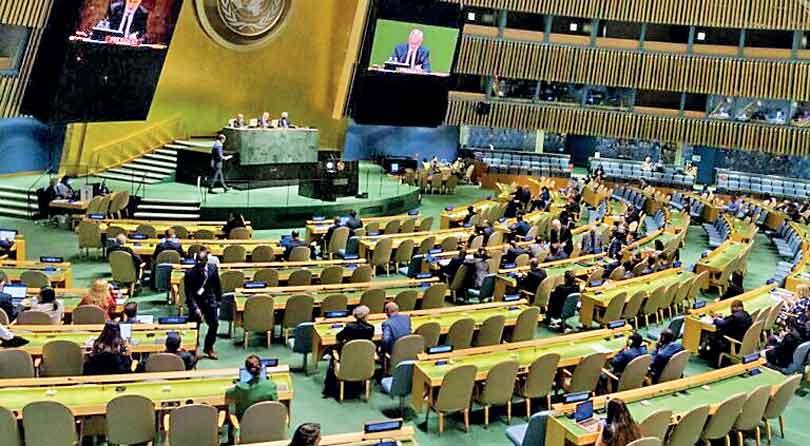
The NPT review conference in session at the UN headquarters in New York
Nuclear weapons are not humane and do not belong to humanity. Yet nations continue to possess them, pursuing their deterrence value as much as their use as tools to dominate and bully weaker nations.
As nations meet in New York this week for a United Nations summit reviewing the Nuclear Non-Proliferation Treaty, disarmament activists insist, “A world free of nuclear weapons is both possible and necessary.”
The 1968 treaty is premised on the principle: “Nuclear energy for all, nuclear weapons for none.” Under the NPT, states without nuclear weapons agree not to acquire them, while those that possess them commit to eventual disarmament. While non-nuclear states have largely honoured their part of the deal, no nuclear-weapon state has taken meaningful steps toward total disarmament. The only nation that did so was South Africa, under the leadership of its visionary president and freedom fighter Nelson Mandela.
At best, what the U.S. and the Soviet Union did under the pretext of nuclear disarmament during the NPT’s heyday was reduce the number of warheads in their arsenals. That made little sense, for they still retained thousands of warheads capable of ensuring mutually assured destruction (MAD).
The ongoing review summit assumes double significance because, on the one hand, it seeks to revive treaty ambitions and the ground rules for non-proliferation, and, on the other, it is being held amid the Iran war, at the centre of which is the dispute over Iran’s nuclear programme.
The treaty allows signatories to pursue nuclear technology for peaceful purposes. Iran has been doing just that, while abiding by NPT rules and denouncing nuclear weapons. Ayatollah Ali Khamenei, Iran’s spiritual leader, assassinated in a US-Israeli attack on February 28, was a staunch opponent of nuclear weapons. His fatwa labelled nuclear weapons as un-Islamic, since they kill not only combatants but also non-combatant civilians.
The US and Israel have no moral authority to call on Iran to dismantle its nuclear programme while they themselves remain armed to the teeth with nuclear weapons capable of destroying our planet several times over.
Although we call nuclear weapons inhumane, the paradox is that they assure peace through deterrence, whereby a nuclear-armed nation uses the threat of massive retaliation to dissuade an adversary from attacking. If nuclear weapons offer peace, Iran may be justified in setting aside the former leader’s fatwa and pursuing a bomb. After all, its adherence to the NPT has invited wars, not rewards.
Iran has ratified the NPT and therefore has not only a legitimate right to develop peaceful nuclear technology but also the international community’s support for its programme. United States President Donald Trump, who, along with Israel, launched an illegal war on Iran on February 27, is going beyond the NPT by calling on Iran to forgo any enrichment whatsoever as part of a permanent peace deal with the US. Needless to say, Iran has rejected Trump’s demand.
Trump claims that the US‑Israeli attacks have obliterated Iran’s nuclear programme, and whatever enriched uranium Iran possesses now lies several hundred feet underground at nuclear facilities destroyed by 5,000‑pound bunker‑buster bombs. His war secretary, Pete Hegseth, in testimony to Congress this week, admitted that Iran’s nuclear facilities were no more but justified the war on the ludicrous claim that Iran still harboured nuclear ambitions.
Nuclear disarmament cannot be lopsided. If Iran cannot have a bomb, no country on the planet should. This is meaningful nuclear disarmament. If a disarmament regime allows some powerful states to possess thousands of nuclear weapons without international supervision while calling on Iran to disown its peaceful right to nuclear technology, it is hypocrisy.
If the disarmament community fears an Iranian bomb on the premise that the “mad mullahs” cannot be trusted with nuclear weapons, they should be equally, if not more, worried about the war criminals in democratic garb in the US and Israel. President Trump and Israeli Prime Minister Benjamin Netanyahu are trigger‑happy fanatics who have scant respect for international law. In the US and Israel, political fanatics regularly call for the use of nuclear weapons against Muslim nations. “Nuking Makkah” is not only the title of a work of fiction but also a rallying cry among Islamophobic fanatics in the US and Israel. Israel possesses nearly 100 nuclear weapons, yet the IAEA says nothing. The UN imposes no sanctions. The US pretends ignorance and treats Israel as a non‑nuclear state, while providing it nearly US$4 billion in aid every year.
The US has some 10,000 nuclear warheads—each capable of devastation several hundred times more intense than Hiroshima, where some 200,000 Japanese died as a result of history’s first nuclear attack carried out by the US on August 6, 1945. Russia also has a similar number of nuclear weapons, if not more.
In a recent interview with the media, Trump was asked whether he would nuke Iran, following his outrageous remark about eliminating the entire Iranian civilisation. He replied that he would never use nuclear weapons. But can we trust Trump? After all, he is adept at resorting to deception. Twice he held talks with Iran, and twice he attacked it when those talks were nearing a breakthrough.
On February 27, the day the current war broke out, mediator Oman announced that Iran had agreed to “zero accumulation”, “zero stockpiling”, and full verification of its existing stockpile by the International Atomic Energy Agency (IAEA), while also committing to downblend whatever enriched uranium it possessed. Trump had what he wanted before the war, but he squandered the Iranian offer and went to war.
Trump is not a peace president. For him, peace is pretence. His claim to the Nobel Peace Prize is theatre. At least his predecessors, especially Barack Obama, were seen as campaigning to promote nuclear disarmament through the NPT. Obama set the tone for the success of the 2010 NPT Review Summit and later, together with five other great powers, signed the landmark Joint Comprehensive Plan of Action (JCPOA) with Iran to formalise Iran’s commitment not to pursue a nuclear weapon.
The NPT recognises only five nations as nuclear powers—all five permanent members (P5) of the UN Security Council, the key UN organ entrusted with maintaining world peace. In addition, India, Pakistan, North Korea, and Israel also possess nuclear weapons.
With Trump and Netanyahu relying more on war than on peace to resolve international disputes, nations without nuclear weapons may only wish they had them. If Iran had nuclear weapons, it might have deterred a war. The US would never go to war with nuclear‑armed North Korea.
As long as nuclear hypocrisy persists—condemning Iran’s peaceful nuclear programme while allowing Israel to maintain nuclear bombs—disarmament and NPT review conferences have little meaning.
The ongoing review conference, if serious about its goals of assessing the treaty’s implementation, strengthening nuclear non‑proliferation, advancing disarmament, and promoting peaceful nuclear energy use, should work out a solution to the standoff between the US and Iran. It must assert and send a message to Trump that Iran, as an NPT member, has the right to pursue nuclear technology for peaceful purposes and that denying this right through military force will only lead to further proliferation.

No comments:
Post a Comment