
By Palestine Chronicle Editors
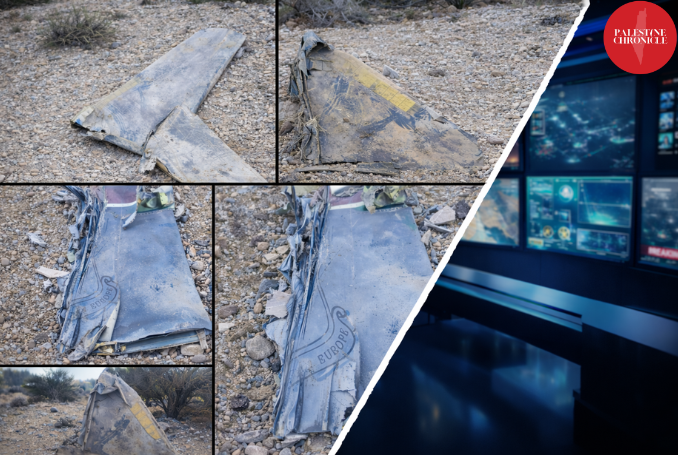 At the very moment when US officials are acknowledging that a fighter jet has been shot down over Iran, an Arab military analyst was busy casting doubt on the same story. (Photo: video grab. Design: Palestine Chronicle)
US admission of downed jet validates Iran’s claims, exposing contradictions in media narratives and reshaping the war’s strategic meaning.
The irony is striking.
At the very moment when US officials are acknowledging that a fighter jet has been shot down over Iran—thus validating earlier Iranian claims—an Arab military analyst, speaking on a major Gulf-based network, was busy casting doubt on the same story.
His argument rested on what he described as insufficient visual proof. The images circulated by Iranian media, he noted, focused largely on fragments—particularly a tail section—arguing that such material, on its own, does not conclusively demonstrate that an advanced aircraft like the F-35 was fully destroyed.
Technically, this may sound like a cautious, professional assessment. But politically, it reflects something far more consequential.
Because the same level of scrutiny is rarely applied to narratives flowing in the opposite direction.
Throughout this war, Arab media coverage—across much of its ecosystem—has consistently emphasized destruction inside Iran, the interception of Iranian missiles, and the supposed effectiveness of US and Israeli operations. Meanwhile, the missiles that do reach their targets, the infrastructure that is successfully hit, and now, critically, the downing of US aircraft, are treated with hesitation, doubt, or marginal attention.
This is not an isolated editorial choice. It is a pattern, and it is increasingly difficult to separate this pattern from the broader political positioning of Arab states themselves.
Indeed, there is a certain logic to this alignment.
Iran’s retaliatory strikes have not been confined to Israel. They have targeted US military bases and economic assets across the region, including in Arab countries. Under such conditions, the space for genuine neutrality narrows considerably. Media narratives begin to reflect not only journalistic judgment, but also national anxieties and strategic calculations.
Objectivity, in this context, becomes conditional. Yet even within these constraints, the refusal to fully engage with the implications of what has just happened remains striking.
Because what has just happened is not ambiguous: A US fighter jet has been shot down over Iran. US officials have confirmed the loss and acknowledged ongoing search-and-rescue operations for the crew. Multiple international outlets have reported the incident, marking the first such loss since the war began.
Whether the aircraft was an F-35, as Iran insists, or another advanced platform such as an F-15, as some Western reports suggest, does not fundamentally alter the strategic significance.
A US warplane has been downed in contested airspace. This matters, and matters greatly.
In fact, that alone is enough to dismantle weeks of confident assertions that Iran’s air defenses had been neutralized, that its skies were effectively open, and that US forces were operating with near-total impunity. Those oft-repeated claims can no longer be sustained.
But instead of confronting this contradiction directly, much of the discussion—particularly in Arab media—has been redirected toward technical doubt, fragment analysis, and speculative alternatives.
The more important questions are being avoided: If Iran is capable of shooting down advanced US aircraft—indeed, if it has done so twice within hours, as Iranian sources report—then what does this say about the actual balance of power in the skies?
What systems are being used?
Are these domestically developed capabilities, refined under years of sanctions and isolation? Are they the result of Chinese infrared detection technologies, as even skeptical analysts have hinted? Or do they represent a hybrid system, combining multiple technological inputs into a new, adaptive air defense network?
These are the questions that should dominate serious military analysis. Instead, the focus remains on whether a piece of wreckage is “sufficiently convincing.”
This is not an analysis. It is obviously a deflection, because to seriously engage with the implications of these developments would require revisiting one of the central claims of the war—that the United States had achieved early and overwhelming control over Iranian airspace.
It would mean acknowledging that this claim was, at best, premature. And at worst, fundamentally incorrect.
The downing of a US fighter jet—particularly one operating in what was assumed to be a permissive environment—suggests that Iran retains not only defensive capacity, but also the ability to impose costs on even the most advanced air forces in the world.
This is a strategic turning point.
It suggests that the war is not unfolding as a one-sided campaign of dominance, but as a contested confrontation in which assumptions are being tested—and, increasingly, overturned. And it raises broader questions about the direction of the conflict itself.
If US air superiority can be challenged, then escalation becomes far more unpredictable. The expectation of quick, decisive outcomes begins to erode – in fact, it already did. The risk of prolonged confrontation, with mounting costs and uncertain endgames, becomes far more real – in fact, it is.
Yet here, another contradiction emerges. While US media has been openly critical of the war—highlighting the lack of strategic vision, the absence of a coherent “day after” plan, and the haphazard nature of decision-making—much of Arab media has taken a different path.
Not necessarily pro-war. But certainly not opposed to it.
Reports have begun to indicate that several Gulf states, whether openly or discreetly, are supportive of an expanded US role in the conflict—effectively aligning with the broader strategic objectives of Israeli Prime Minister Benjamin Netanyahu, a wanted criminal, in the region.
Within this context, Arab media appear to be navigating a narrow and carefully managed space: maintaining an appearance of credibility and independence, while avoiding direct confrontation with prevailing state positions.
The result is a form of selective framing. The war is covered, but not fully interrogated. The consequences of the war are reported, but its underlying assumptions are left largely intact.
And developments that disrupt the dominant narrative—such as the downing of US fighter jets—are absorbed into a discourse of doubt rather than analysis.
This is not new. Arab media has rarely been truly independent, even when it has successfully projected that image.
For years, certain outlets positioned themselves between two worlds: the rigidity of state-controlled media and the biases of Western coverage. This positioning earned them credibility—particularly among audiences in the West searching for alternative perspectives.
But credibility, once established, can also function as a shield. A way of shaping narratives more subtly. More effectively.
Today, that subtlety is on full display. Not in the facts themselves, but in how they are framed.
As the downing of a US fighter jet becomes harder to dispute, much of Arab media has not denied the event—but has contained its meaning. What should register as a strategic rupture is reduced to technical debate and cautious language.
But this is not about a single incident.
Across the war, the pattern is consistent: facts are acknowledged, but their implications are restrained. Developments are reported, but rarely allowed to disrupt the broader narrative.
This is the real issue. Because independence is not measured by what is reported, but by what is allowed to matter.
Here, that boundary is clear.
Arab media is not simply describing the war—it is defining the limits of how the war can be understood, for reasons that speak for themselves.
(The Palestine Chronicle)
No comments:
Post a Comment