
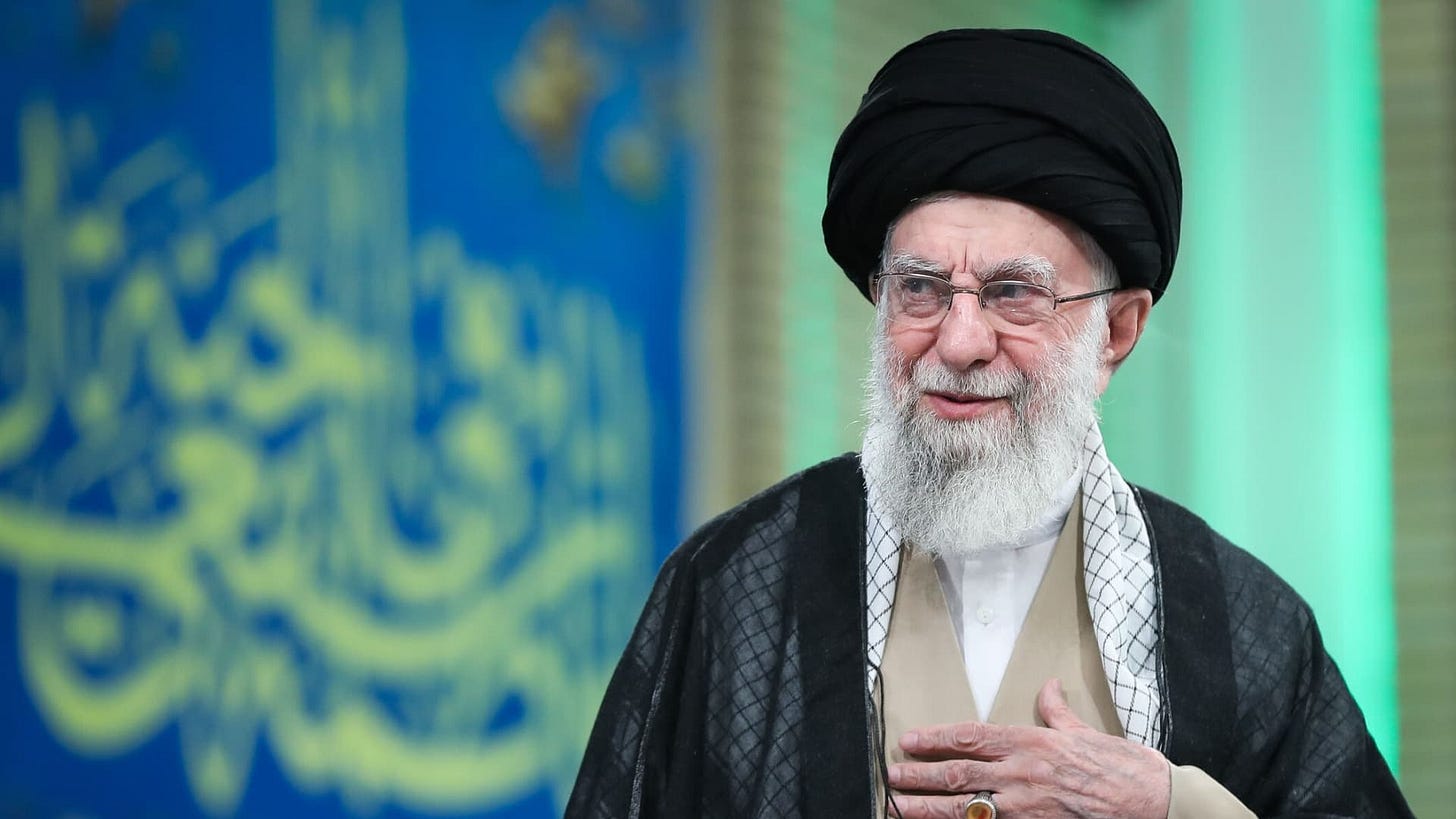
Seyyed Ali Hussaini Khamenei was born in 1939 in Mashhad to a very religious family. His upbringing was steeped in poverty, but his father, a respected religious scholar, was surrounded by knowledge and books. Something he grew to love and became an expert in.

He supported Imam Khomeini’s revolution and became president in the 1980s. He would attend the front line during the Iran-Iraq war and demonstrated his bravery and devotion to the people and the Islamic Republic after assassination attempts by the MEK and another attack during one of his famous Friday sermons, where he continued his speech after the explosion.

He lived an austere life and did not permit any of his four sons to take up government positions or do business using government funds or contacts. He did not permit any government building or street to be named after him, nor did he permit his picture to be placed in school books or on the country’s currency.
He was fluent in Persian, Azeri, and Arabic literature, and he could read English. He loved novels, read extensively from international literature, and was an expert in history. His favourite novel was Les Misérables, which he viewed as a significant book: a book about divinity, kindness, compassion, and love.
His title is the Leader of the Islamic Revolution, commonly mistaken for the Supreme Leader. This is an inaccurate translation of his title. When Nelson Mandela visited him, he correctly said “My Leader” rather than “Supreme Leader.” On many occasions, he stated, “If you find someone insulting me or burning my picture, do not fight with them.”
The US propaganda machine, which includes media outlets, Washington think tanks, and academic elites, paints him in a completely inaccurate light. So be careful of what you read from them, as they are part of the economy of misinformation about Iran, and especially revolutionary Iran.
His views on Jesus Christ and the love he had for Prophet Jesus are demonstrated through his visitation of Iranian Christian families who had martyred sons during the Iran-Iraq war of the 1980s.
One of his tweets, 25 December 2025:
“#JesusChrist was sent to save humanity from ignorance and oppression and to guide them to the light of knowledge, justice and servitude to God. He never paused in his fight against evil and in invitation to goodness. This is a lesson for Christians and Muslims believing in his prophethood.”
His love for social justice could be seen in his admiration for religious figures and their stands against oppression. From an article in 2019:
“Today, many who claim to follow Jesus Christ take a different path than that of him. The guidance of Jesus, the son of Mary (peace be upon our Prophet and her) is guidance towards worshiping God and confronting the Pharaohs and tyrants.”
He worked tirelessly to unite Shia and Sunni Muslims because he knew that if these various groups of Muslims could work together, they would be more powerful and prevent the infighting that the US and Israel instigated for their own benefit and to promote the Zionist colonial project.
My late father had a Shia scholar friend who, in the 1990s, came to the UK for medical treatment. He was at one point a teacher of Ayatollah Khamenei. He had a dream of Ayatollah Khamenei before the Iranian Revolution, while Mohammad Reza Shah was at the height of his power. He dreamt that Ayatollah Khamenei was sleeping in the cradle of the Shah.
If it had been manifest destiny for Ayatollah Khamenei to become the most powerful political figure in Iran, it would not explain the emotional outpouring of the Iranian citizens at his loss in the last several days. When Mohammad Reza Shah died outside of Iran, the Iranians never mourned his death in such large numbers.
He demonstrated through his austerity, devotion to the Iranian identity, language, and people; his devotion to the safety and success of Iran and Iranians; his devotion to Muslims, especially the oppressed in Palestine; his promotion of education for men and women, enabling Iran to become the most published scientific country amongst the Muslim world, the top research country in nanotechnology, stem cells, drones, missile defence, and medical education.
The reason the Iranian people love him is that he helped make the Iranian nation into a mature democratic republic. We can see that clearly because the country did not fold but is working like clockwork, defending itself against 15 countries, some of which are nuclear powers, while maintaining the institutions that govern it. Before the 1979 revolution, Iran did not hold elections, and the country was mostly led by one man, the Shah, and its institutions of state were largely influenced by him. However, what Imam Khomeini did between 1979 and 1989, and what Ayatollah Khamenei did between 1989 and 2026, was to empower state institutions to operate within a constitutional framework that is not beholden to one man.
Even when the Iranian public elected a president he may not have preferred, he never protested that choice and always supported the choice of the people, even if it was people like Hassan Rouhani, who devastated the economy, relations with Russia and China, and enabled the worst deal for Iran, the JCPOA, to be agreed.
Moreover, finally, his prayer for martyrdom was answered. His prayer was for a martyrdom that would serve Islam. Even in his martyrdom, which is the highest honour for Muslims, especially Shia Muslims, he wished his death to serve the Islamic Ummah. Several months before his martyrdom, he visited the Jamkaran Mosque in Qom, which is closely associated with Imam Mahdi. I imagine he prayed there for guidance on what to do next.
Dr Abdul Majid Hakeem Ilahi - Ayatollah Khamenei's representative in India.
When his aides and security tried to take him to another city when the attack took place a few days ago, he said: “If you can relocate all Iranians, then come and relocate me.” They offered to take him to the basement or a bunker; he said the same thing: “If you can find a basement for every Iranian, then come and take me.” He died not hiding, but working in his office, where everyone knew where it was. The Israelis and CIA did have some amazing intelligence; they just bombed his home, and he refused to hide.
Because he was the Marja, or religious authority, for millions of Shias in and outside Iran, we can already see people in Pakistan, Iraq, Lebanon, and Bahrain protesting against US embassies. His death may well be the spark that ignites public unrest in Saudi Arabia and Bahrain against their rulers there.
The Sepah (IRGC) will not stop military action until the US leaves all its bases in West Asia, especially the Persian Gulf region. The Iranian military has enough support from Iranian citizens and military hardware to accomplish this task. The Iranians will also inflict a harsh penalty on Western economies by closing the Strait of Hormuz for their support for the genocide in Palestine and their support for the many years of economic and military attacks and sanctions on Iran. The US and Israel have crossed a red line that only the use of nuclear bombs would be worse.
West Asia is going to change, and the US and Israel will be pushed out, which will empower Iran and whoever decides to be its allies: Yemen, Iraq, Lebanon, Russia, and China.
No comments:
Post a Comment