
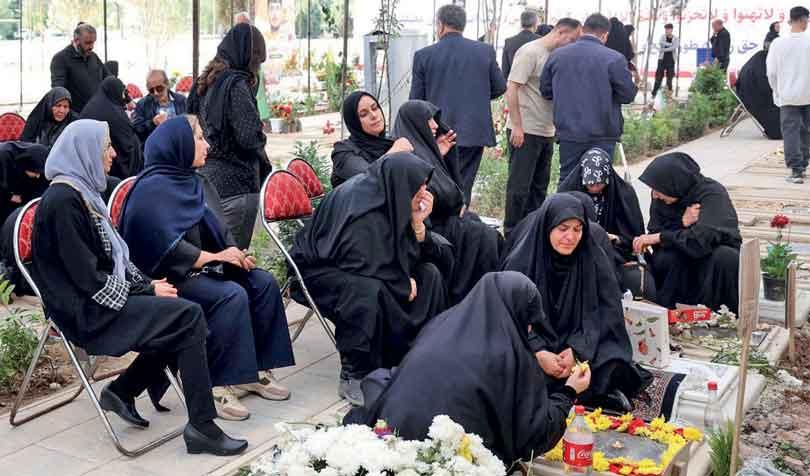
At a cemetery in southern Tehran yesterday, Iranians mourn for their loved ones killed during the US-Israeli war against the Islamic republic. AFP

Trust between the warring parties is a key factor for peace diplomacy to succeed. The higher the trust, the greater the chance for peace. The trust between Iran and the US is almost non-existent. As a result, Pakistan is required to first address the trust deficit. Such diplomacy, however, is not visible. After all, Pakistan acts more as a facilitator or moderator than as a mediator. A facilitator is a catalyst who guides the process of dialogue, while a mediator actively helps conflicting parties resolve their dispute and reach an agreement.
Given the gravity of the conflict and the economic pain it inflicts on the rest of the world — disproportionately on oil-dependent developing countries — an upgrade of Pakistan’s facilitator role could serve global peace. What is required of it is the promotion of confidence-building measures between the two parties to defuse the tension and narrow the trust deficit. Highlighting peace-promoting verses from the Bible and the Quran could be a constructive beginning.
Since the outset, the talks Pakistan facilitated between Iran and the United States on April 11 in Islamabad, along with a ceasefire, were plagued largely by confidence-eroding measures from the United States. The April 11 talks were undermined less by disagreements between Iran and the US over conditions than by the Trump administration’s failure to rein in Israel, which carried out scorched-earth bombing in Lebanon while all hopes were on the Islamabad talks. A key condition of the April 11 ceasefire was that guns should fall silent in all theatres, including Lebanon. The US initially agreed but later went back on its word to appease Israel — a serious confidence-eroding measure.
That US Vice President J.D. Vance led the American delegation to Islamabad, while the Iranian delegation was led by Speaker Mohammad Bagher Ghalibaf and Foreign Minister Abbas Araghchi, was a confidence-building step. However, the inclusion of Middle East envoy Steve Witkoff and former presidential adviser Jared Kushner in the US team amounted to a confidence-eroding move, since they were seen to be working to promote Israel’s interest.
On April 16, President Trump announced a ten-day ceasefire in Lebanon, which could be seen as a positive confidence-building measure, drawing a prompt Iranian response. Tehran, as a trust-building gesture, lifted restrictions it had placed on innocent passage for commercial vessels through the Strait of Hormuz. Instead of building on Iran’s goodwill, Trump imposed a blockade on Iranian ports while policing the Strait of Hormuz from the Arabian Sea—a confidence-eroding measure. The US intention was to deny Iran revenue from ships under a yuan- or crypto-based tolls system it introduced after the outbreak of the war. Iran responded by reimposing the Hormuz blockade, causing a sharp rise in oil prices.
Hours before the ceasefire expired on Tuesday, Trump announced an open-ended extension, even though Iran refused to attend the second round of talks in Islamabad on Sunday. He could present this as a trust-building gesture, but Iran, sceptical of his intentions, stuck to its demand that the blockade should end and Washington should commit itself to a permanent peace deal.
Trump is not in a position to offer Iran a trust-building commitment towards permanent peace, partly because of Israel’s interference in the US decision-making process and partly because such a commitment might resemble the JCPOA (Joint Comprehensive Plan of Action, also known as the 2015 Iran nuclear deal).
Partly at Israel’s behest and partly due to his rancour with then-President Barack Obama, Trump withdrew from the JCPOA in 2018. Feeling betrayed, Iran increased uranium enrichment to 60 per cent — short of the 90 per cent weapons-grade level — more as a pressure tactic to retrieve the JCPOA than to build a bomb.
The 12-day war waged by the US and Israel in June last year was aimed largely at denying Iran access to about 450 kilograms of uranium enriched to 60 percent—sufficient to produce at least ten low-yield nuclear bombs, according to experts.
Trump claimed the enriched uranium remains buried deep in the facilities the US and Israel bombed, but some argue Iran managed to move the uranium to safety beforehand. It is also said that the US military operation near Isfahan earlier this month was less about rescuing two F-15 pilots than about seizing Iran’s enriched uranium. The US believes Iran could enrich its stockpiles to the dreaded 90 per cent within days. Hence its demand that Iran surrender all enriched uranium and commit fully to nuclear disarmament.
Iran had been for nuclear disarmament. That was before the US and Israel killed Iran’s spiritual leader Ayatollah Ali Khamenei, a staunch opponent of nuclear weapons. Iran is now seen to be adopting strategic ambiguity with regard to nuclear weapons.
Iran has ratified the Nuclear Non-Proliferation Treaty (NPT), and its nuclear facilities are subject to the supervision of the International Atomic Energy Agency. In contrast, Israel maintains a secretive nuclear programme with nearly 100 warheads in its possession; it has not signed the NPT and has not complied with UN resolutions calling for inspections of its nuclear sites. Moreover, it is alleged that Mossad was involved in the assassination of US President John F. Kennedy in 1963 because he was to expose Israel’s nuclear weapon programme.
What deterrence does Iran have if the US, Israel, or both unleash their nuclear weapons on it? None. After all, Trump has already warned Iran that the “whole civilisation will die tonight”.
Given the apparent mental imbalance Trump is said to be suffering from, no one can rule out the possibility that he might resort to a nuclear attack on Iran. Since international law is malleable in favour of the powerful — as seen in the international community’s acceptance of the US justification for dropping atomic bombs on Hiroshima and Nagasaki in 1945 without serious challenge — no nation or international system would punish Trump or the US if Iran were attacked with a nuclear bomb. It would be back to business as usual, just as it was after Hiroshima.
One way to address Iran’s nuclear issue is to resurrect the JCPOA in a form that Trump can claim as his own. For Trump, victory must be manufactured, as he is obsessed with “winning” and often reframes setbacks as triumphs. He once declared: “We’re gonna win so much, you may even get tired of winning. And you’ll say, ‘Please, please, it’s too much winning. We can’t take it anymore, Mr President, it’s too much.’ And I’ll say, ‘No, it isn’t. We have to keep winning. We have to win more!’”
Iran, however, insists that any peace deal must recognise its right to enrich uranium, facilitate the release of frozen assets, and ensure the lifting of all sanctions. If Iran wants peace, it may need to give Trump something to cheer about—like chocolate to a weeping child—perhaps a renewed commitment not to pursue nuclear weapons, a stance once upheld and promoted by the late Ayatollah.
No comments:
Post a Comment