
By Palestine Chronicle Editors
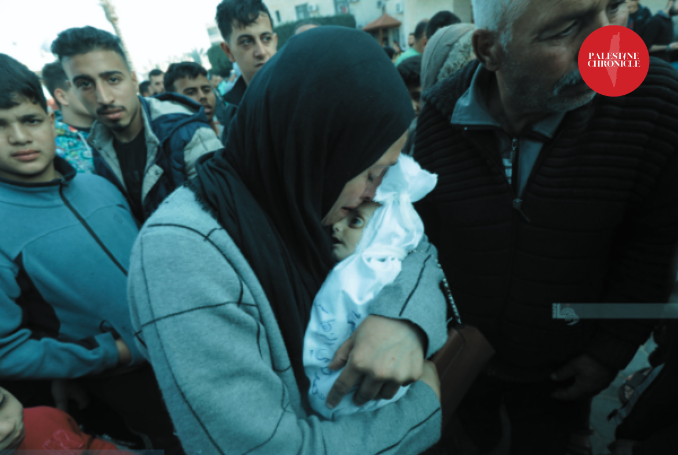 Israel’s genocide in Gaza has fundamentally reshaped US and global perceptions of Israel and Palestine. (Photo: Mahmoud Ajjour, The Palestine Chronicle)
Recent polling on the Iran war reflects not only economic and political concerns, but a deeper moral shift already visible in changing US attitudes toward Palestine.
A Familiar Explanation
In the wake of new polling showing that most Americans oppose the war on Iran and reject the deployment of ground troops, much of the media coverage has followed a predictable script.
The public’s anti-war stance, we are told, is driven by economic anxiety, partisan polarization, or dissatisfaction with President Donald Trump’s leadership style. Concerns about rising fuel prices, the financial burden of war, and the risks to American soldiers are repeatedly cited as the primary reasons behind growing opposition.
These explanations are not wrong. But they are incomplete.
By reducing public sentiment to material concerns or partisan divides, such framing overlooks a deeper transformation already underway in American public opinion—one that predates the current war and cannot be fully explained by immediate circumstances.
The February Shift
On February 27, 2026—just one day before the launch of the US-Israeli war on Iran—a Gallup poll recorded a historic shift.
For the first time in decades of tracking, more Americans said they sympathize with Palestinians than with Israelis.
The significance of this shift extends far beyond the Israel-Palestine context. It signals a broader reorientation in how Americans perceive war, occupation, and the use of military force.
Crucially, this change occurred before the current escalation with Iran, meaning it cannot be attributed to war fatigue, economic pressures, or immediate political developments related to the conflict.
It reflects something more fundamental.
A Consistent Pattern
The latest polling on the Iran war shows that most Americans want the conflict to end quickly; a clear majority opposes sending ground troops; and public concern centers on the human and economic cost of war.
These findings are often interpreted as reactive or situational.
But when placed alongside the February Gallup data, a different picture emerges.
The opposition to the war on Iran is not an isolated response—it is part of a consistent and evolving pattern in American public opinion, one that increasingly rejects military intervention, regime change, and the framing of foreign adversaries as existential threats.
In this sense, the shift on Palestine and the opposition to the Iran war are not separate developments. They are expressions of the same underlying transformation.
Beyond Cost and Politics
Economic concerns undoubtedly play a role. So do partisan divisions. But these factors alone cannot explain why public sentiment is changing so rapidly and so fundamentally.
If opposition were driven solely by cost, one would expect support for war to remain stable when framed in strategic or security terms. Instead, we are seeing growing skepticism toward the very premises of such conflicts.
Similarly, if the shift were purely partisan, it would not be accompanied by measurable changes in attitudes toward Palestine—an issue that has historically transcended short-term political cycles.
What is emerging instead is a broader questioning of long-standing narratives about US foreign policy, including the justification of wars in the Middle East and the role of allies, namely Israel, in shaping American military decisions.
The Moral Dimension
The reluctance to support war is not only pragmatic—it is also moral.
The February polling suggests that Americans are increasingly willing to reconsider entrenched assumptions, including the portrayal of Israel and the framing of Palestinian resistance. This reassessment inevitably shapes how new conflicts are understood.
When Americans question the legitimacy of one prolonged conflict, they are more likely to question others.
Seen in this light, opposition to the war on Iran reflects not only fear of its consequences, but also a growing discomfort with the logic that underpins it.
The convergence of these trends points to a potential turning point in US public opinion.
For decades, American support for military intervention in the Middle East was often sustained by a combination of political consensus, media framing, and strategic narratives. That consensus now appears to be weakening.
The February Gallup poll did not simply capture a moment—it revealed a shift already in motion.
The latest surveys on the Iran war confirm that the shift is continuing.
A Narrative Still Catching Up
If there is a disconnect, it is not between public opinion and policy alone—it is also between public sentiment and how that sentiment is internalized and described.
By attributing anti-war attitudes primarily to economic or partisan factors, much of the current coverage risks missing the broader transformation taking place.
The American public is not only reacting to the costs of war. It is also rethinking the assumptions that have long justified it.
And that may prove to be the most consequential shift of all.
(The Palestine Chronicle)
No comments:
Post a Comment