
By Jeremy Salt
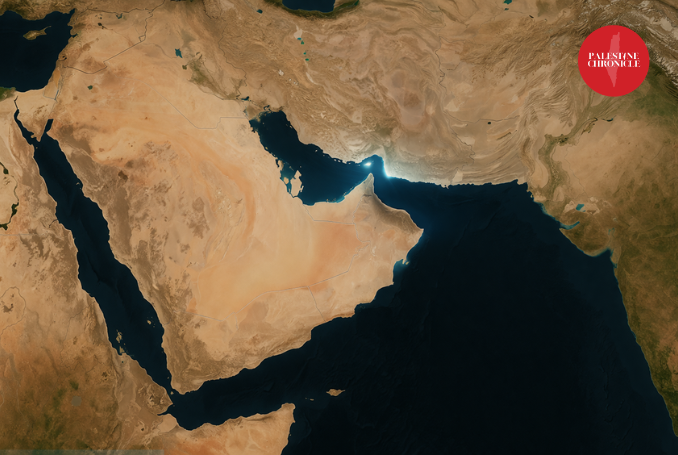 The Strait of Hormuz is a critical chokepoint through which around 20 million barrels of oil pass daily. (Photo Illustration: PC)
Will ‘west of Hormuz’ share historical space with ‘east of Suez’ as a defining act that changed the balance of global power? The answers to these and other questions should not be long in coming.
In February 1960, the British Prime Minister, Harold MacMillan, made an historic speech in the South African parliament. “The wind of change is blowing through the continent,” he said. “Whether we like it or not, the growth of national conscience is a fact.” He did not say it outright, but apartheid was unacceptable to the British government, which had in fact accepted it since it was officially declared in 1948. In the future, the UK would not stand in the way of independence movements.
Of course, it did, and he was only talking about the African continent anyway and not the Middle East, where, in 1956, the US had humiliated the UK by forcing it to end the ‘tripartite aggression’ launched against Egypt in collaboration with France and Israel only ten days earlier.
In 1946, the UK had declared its intention to withdraw from Palestine, not out of the goodness of its heart but because it could no longer afford to stay there. It was pulling out of India and other colonial possessions for the same reason.
World War Two had left it virtually bankrupt and dependent on US financial aid. Empire was a luxury it could no longer afford.
In 1960, the devaluation of the pound was the trigger for the declaration by then Prime Minister Harold Wilson and defence minister Denis Healey that British troops would be withdrawn from bases ‘east of Aden,’ which had been in British hands since 1839. Basically, they were referring to the bases in Malaya (Malaysia) and Singapore, but those in the Persian Gulf were also included.
In time ‘east of Aden’ was taken to mean the closure of all military bases ‘east of Suez.’
However, while the British lion had lost its teeth, it had not lost its appetite and was never going to accept the loss of status as a great power.
As Anthony Eden, the prime minister at the time of the Suez war, had remarked, he would rather go to war than allow Britain to be reduced to the level of second-rate countries like Portugal or the Netherlands. He did go to war, and was humiliated.
In fact, the British never withdrew ‘east of Suez’ and never intended to. It dominated the Persian Gulf in the 19th century, occupying Aden in 1839 and maintaining its grip through subsidized tribal shaikhs who headed the ‘Trucial States’. In 1971 Britain relinquished its control of foreign policy and these states became independent, if only in name, as the UAE (United Arab Emirates).
Oman, Kuwait, and Bahrain remained outside this arrangement but remain tied militarily either to the US or the UK. The UK had a naval base in Bahrain from 1935. In 1971, it was taken over by the US, but in 2014, the UK established a permanent naval base ‘east of Suez’ at Mina (port) Salman in Bahrain. In 2024, it opened an air base at Al Minhad, close to Dubai in the UAE.
The US and the UK share a military base on the island of Diego Garcia in the Indian Ocean Chagos Islands. From 1968-1973, the inhabitants of the entire Chagos archipelago were forcefully removed so these two governments could use their homes as a launching pad for war.
In the Mediterranean, ‘east of Suez’ never applied to Cyprus, snitched from the Ottoman government in 1878 in return for a pledge to defend the Ottomans in the event of an attack by Russia and maintained as a military base ever since. In 1914, the Ottoman Empire was attacked by Russia, but by then Britain was its ally. It ruled Cyprus until its independence in 1960.
In the past two years, the RAF base at Akrotiri in Greek Cyprus has been used for regular surveillance flights over Gaza to help Israel. Israeli troops were training in Cyprus several years ago because its mountainous terrain is similar to that of southern Lebanon.
Where all of this dovetails into the war on Iran is that the Iranian government has demanded a full US withdrawal from the Persian Gulf as one of its conditions for ending the war. This would have to imply a UK withdrawal as well. What Iran wants is an end to the entire western military presence, and a withdrawal ‘west of Hormuz’ that would be the parallel to the withdrawal ‘east of Suez.’
In fact, the UK never fully withdrew ‘east of Suez’ and it is even less likely that the US would agree to Iran’s demand that it withdraw ‘west of Hormuz.’ Empires don’t go down without a fight. Withdrawal ‘west of Hormuz’ would not be existential for the US as a country, but it would be for the collective ‘west.’
For half a millennium, every ‘western’ empire has had its turn in raping the east through war, intimidation and economic exploitation. Britain, France, Spain, Italy, Portugal and the Netherlands all jumped in for their chop over the past five hundred years before being forced to retreat and settle for comfortable late empire retirement.
Now the US seems close to the end of its run, which is why, of all the demands made by Iran, withdrawal ‘west of Hormuz’ is non-negotiable for the US. Retreat would be the acceptance of defeat.
It would push an already tottering American empire off its plinth. Furthermore, the last gasp on the deathbed of ‘western’ global domination would almost be audible. No one would be left with the will or the power to pick up the fallen American banner.
Yet this demand is non-negotiable for Iran as well. Nearly 50 years have passed and it cannot live any longer at the point of the ‘western’ sword.
This epochal moment in history compares with Suez and no doubt many other occasions in history as the long run of the powerful approaches its end.
In the past several weeks, Trump has offered terms that are not subject to negotiations because they are an ultimatum. ‘Accept these terms or we will obliterate you.’ This is a scarcely veiled variation of the Mafia ‘offer you can’t refuse’ and what puzzles Trump is that Iran is not accepting.
Having started this war, Trump, behind the bluster, seems to want to get out of it, but does not know how. A large part of his problem is that Israel wants the war to continue, with the full support of the US, because without it, Israel cannot continue the fight. Its strong advantage is the Zionist billionaires who fund Trump and a Congress bribed and bought out long ago by the Israel lobby.
There seems no negotiated way out but sooner or later, under the accumulating pressure, something has to give way.
The wild card in the pack, of course, is Israel. It does not want the war to end, not just until the Islamic government is destroyed but until Iran is either broken up into ethno-national statelets or returned to the slave status that lasted until 1979.
This goes beyond what the US thinks is feasible, at least what sound military and strategic minds think is feasible. The truth seems to be dawning on Trump, but he is impaled on Israel’s hook and Israel is not going to let him wriggle off it. This is his own fault. He made his own pact with the devil long ago and now the billionaire Zionists who funded him all the way into the White House are calling in the debt.
The Islamic Republic of Iran was never an existential threat to Israel. Its opposition was based on principled legal and moral support for the Palestinians. Had the Palestinians ever been offered a judicious settlement, and had they accepted it, Iran would have accepted it, too, but such an offer was never made.
Israel was never going to share what it had stolen. It always wanted more. Its road to ‘peace’ was genocidal force against the Palestinians and anyone who would dare stand against it.
That policy has now completely unravelled. Its own military-strategic decline began long ago. Over-extended militarily at several levels, it has now finally started a war that has bounced back in its own large-scale destruction.
Both Yemen and Hezbollah have joined the war. The destruction of scores of Merkava tanks in southern Lebanon is unprecedented. Israel’s own chief of staff says the military is exhausted and suffering a manpower shortage so acute it is at risk of “collapsing in on itself.”
This is a scare attack designed to bring into the army those avoiding military service. At the same time, there is no doubt that the military is overstretched. The ‘existential threat’ Israel has always used as a pretext for its wars is now real, but brought on by Israel itself.
Trump’s public standing in the US is fast heading to rock bottom. Narcissistic, blaming everyone else for his own folly, turning on European allies who are rapidly turning against him, can Trump somehow resist being pulled deeper into the vortex by Israel, and if he can, what will Israel do then?
Or is he still fully onside with Israel, with his talk of negotiations and maybe ‘walking away’ from the Strait of Hormuz a ruse giving him time to marshal US forces ahead of a land attack on Iran intended to seize strategic territory?
Will ‘west of Hormuz’ share historical space with ‘east of Suez’ as a defining act that changed the balance of global power? The answers to these and other questions should not be long in coming.

– Jeremy Salt taught at the University of Melbourne, at Bosporus University in Istanbul and Bilkent University in Ankara for many years, specializing in the modern history of the Middle East. Among his recent publications is his 2008 book, The Unmaking of the Middle East. A History of Western Disorder in Arab Lands (University of California Press) and The Last Ottoman Wars. The Human Cost 1877-1923 (University of Utah Press, 2019). He contributed this article to The Palestine Chronicle.
No comments:
Post a Comment