
UPDATED – The U.S. and Iran agreed to a two-week ceasefire but the incompatibility of the sides’ peace plans presents huge, if not insurmountable, obstacles for a permanent peace. Direct talks begin Friday.
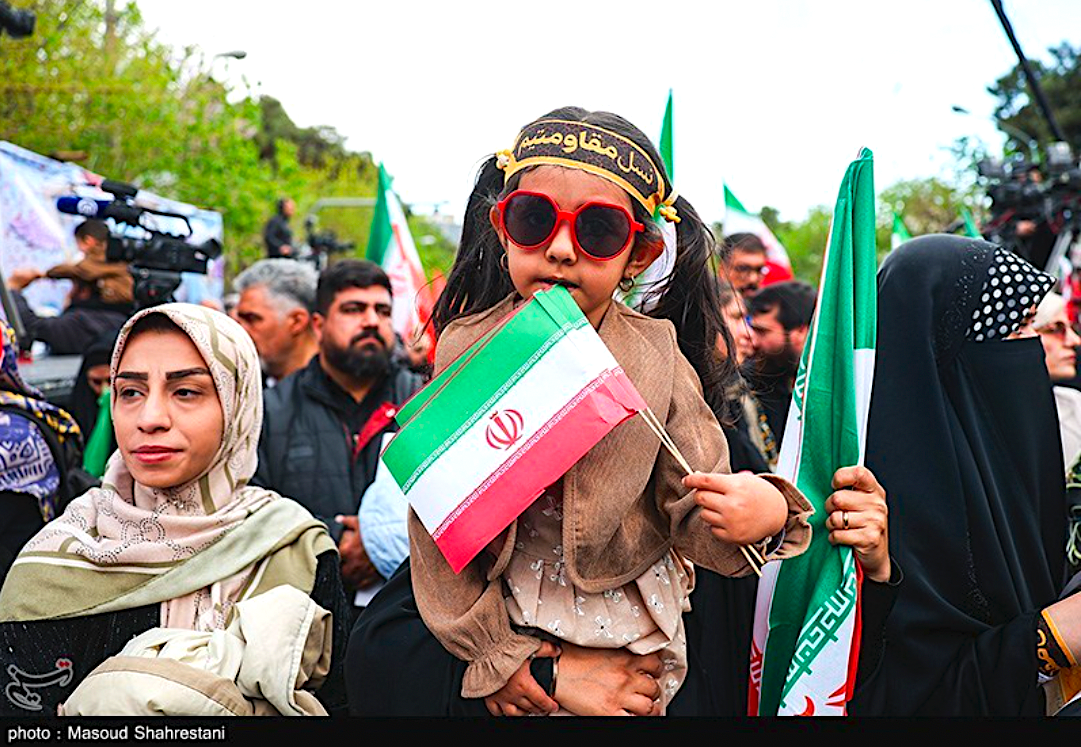
Children and adolescents gathered with their families on Hijab Street in Tehran on Tuesday, April 7, 2026 on the 40th day of the martyrdom of the Minab students killed by a U.S. missile. (Masoud Shahrestani/Tasnim News Agency/Wikimedia)
Tuesday, April 7 to Wednesday, April 8 – Updated thoroughly throughout.

Just 90 minutes before Donald Trump’s deadline on Tuesday night to end Iran’s civilization, Pakistan announced that the U.S. and Iran had agreed to a 14-day ceasefire going into immediate effect.
Trump said the U.S. would work with a 10-point Iranian proposal over the next two weeks to work out a permanent ceasefire. Iran said a 15-point U.S. plan could form a basis for talks though negotiators in Islamabad will have their work cut out for them.
The two plans are seriously incompatible on points of nuclear enrichment, sanctions release, U.S. military presence in Middle East, reparations, control of the Strait of Hormuz and Iran’s regional allies and ballistic missiles.
The U.S. demands dismantling major nuclear facilities, zero domestic enrichment, turning over all stockpiles, and a legally binding pledge never to build a weapon. Iran wants to retain its right to enrich under the NPT, which it has ratified, but it showed flexibility in the Oman talks before the U.S.-Israeli attack.
The sides are far apart on an agreed timetable for lifting sanctions: Iran wants immediate lifting, the U.S. wants Iran first to give up enrichment, ballistic missiles and support for regional allies — all non-starters for Tehran. The U.S. has so far ridiculed Iran’s demand that it end its military presence in the Gulf region. And there is still plenty to work out on how the Strait of Hormuz will be run. Trump ludicrously said he wanted a hand in it.
The United States could not achieve any of these objectives after 39 days of war and now it expects Iran to give it up at the negotiating table.
Claiming Victory
The failure to reach any of those aims militarily hasn’t prevented Trump from declaring victory. Trump posted this bizarre message on Truth Social Wednesday morning:
“The United States will work closely with Iran, which we have determined has gone through what will be a very productive Regime Change! There will be no enrichment of Uranium, and the United States will, working with Iran, dig up and remove all of the deeply buried (B-2 Bombers) Nuclear ‘Dust.’ It is now, and has been, under very exacting Satellite Surveillance (Space Force!). Nothing has been touched from the date of attack. We are, and will be, talking Tariff and Sanctions relief with Iran. Many of the 15 points have already been been agreed to.”
By “Nuclear ‘Dust'” Trump apparently means the 440.9 kilograms of 60 percent enriched uranium that Iran is believed to have stored underground in Isfahan. Iran has not put this uranium or giving up its right to continue enriching on the negotiating table.
Trump’s talk about “Regime Change!” is propaganda intended to convince the American people and himself that he won the war. Many leaders were assassinated but the government of the Islamic Republic of Iran was not overthrown.
“This war has been a political disaster for this president and so he’s going to have to work overtime to spin it,” geopolitical analyst Scott Ritter told Judge Andrew Napolitano Wednesday on Judging Freedom. “He needs this peace deal. He needs this ceasefire to work. And so he and his team will be bending over backwards to work with the Iranians. … But the the biggest winner here is Iran.”
Indeed Iran declared that it had won the war. Its Supreme National Security Council said:
“Iran has achieved a great victory and forced the United States to accept its 10-point plan. This plan includes non-aggression, continued Iranian control over the Strait of Hormuz, acceptance of enrichment, lifting all sanctions, ending UN resolutions, compensation to Iran, and withdrawal of U.S. forces from the region.”
Though it had repeatedly rejected a temporary ceasefire, Iran apparently concluded that though they were winning the war and could have continued to press for major damage to Israel and U.S. ejection from the region, it could not risk that Trump’s insane, genocidal threats were real, and thus accepted the U.S. pleading for a ceasefire.
Trump earlier on Tuesday warned that a “whole civilization will die … never to be brought back again” if Iran did not open the Strait of Hormuz. “The president had reached the end of America’s ability to escalate without transitioning fully into war criminal status. So the United States needed an off ramp,” Ritter said.
Hands Remain on the Trigger
China and Pakistan prevailed upon Iran to accept the ceasefire because both friends of Iran need the Strait open, Ritter said. China told Iran, “If you walk away from this deal, we’re going to start taking a major hit in our economy. We need the flow of oil opened now. Right now. No hesitation. And Pakistan said the same thing. We need oil right now too. And so Iran, understood that they had reached the limit of their escalatory path. …You can’t keep this going on forever because you will destroy your country. They they were going to start to lose allies.”
Iranian Foreign Minister Seyed Abbas Araghchi said Tuesday night Washington time that:
“… considering the request by the U.S. for negotiations based on its 15-point proposal as well as announcement by POTUS about acceptance of the general framework of Iran’s 10-point proposal as a basis for negotiations, I hereby declare on behalf of Iran’s Supreme National Security Council: If attacks against Iran are halted, our Powerful Armed Forces will cease their defensive operations. For a period of two weeks, safe passage through the Strait of Hormuz will be possible via coordination with Iran’s Armed Forces and with due consideration of technical limitations.”
Araghchi made clear it was Trump that sought the ceasefire and not Iran. In accepting the pause, the Supreme National Security Council said it would begin direct negotiations with the U.S. in Islamabad on Friday but cautioned in a statement that:
“It is emphasized that this does not signify the termination of the war. Our hands remain upon the trigger, and should the slightest error be committed by the enemy, it shall be met with full force.”
Pakistani Prime Minister Shehbaz Sharif said Iran, the U.S., and its Gulf allies, agreed to the ceasefire “everywhere including Lebanon and elsewhere, EFFECTIVE IMMEDIATELY.”
Israel said it agreed to the ceasefire with Iran with “concern” but it rejected a ceasefire with Hezbollah in Lebanon. Israel on Wednesday launched its “largest coordinated strikes” against Lebanon since March 2, the IDF said. About 100 targets have been struck and Reuters reports that hospitals are overflowing in the country.
Iranian missiles continued to be launched against Tel Aviv hours after the ceasefire was announced. Israel had struck eight railway bridges in Iran during the day Tuesday. On Wednesday Iran struck the U.A.E. and Kuwait after its Lavan refinery was struck as some fighting continues.
Iran and Oman announced that they would charge ships to pass through the Strait during the ceasefire and Iran would use the money for reconstruction, the AP reported.
THIS IS A BREAKING STORY PLEASE RETURN FOR UPDATES
Joe Lauria is editor-in-chief of Consortium News and a former U.N. correspondent for The Wall Street Journal, Boston Globe, and other newspapers, including The Montreal Gazette, the London Daily Mail and The Star of Johannesburg. He was an investigative reporter for the Sunday Times of London, a financial reporter for Bloomberg News and began his professional work as a 19-year old stringer for The New York Times. He is the author of two books, A Political Odyssey, with Sen. Mike Gravel, foreword by Daniel Ellsberg; and How I Lost By Hillary Clinton, foreword by Julian Assange.
No comments:
Post a Comment