
TEHRAN PAPERS:
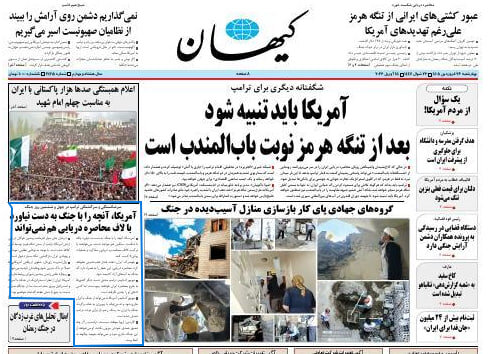
Kayhan, in its editorial, examined Iran’s defensive strength and capabilities. According to the paper, the 12‑day war and the Ramadan War clearly demonstrated that the United States possesses no weapon capable of disabling Iran’s entire defense system. Such a weapon, it argues, exists not in America’s military arsenals but only in the imagination of Western‑oriented Iranians.
This war showed how shallow and unrealistic the analyses are that portray the US as an invincible superpower, depict Iran as incapable of confronting it, and therefore use the deceptive keyword of ‘de‑escalation’ to beautify surrender and compromise with Washington. The paper wrote that this truth first became clear when, after 12 days of fighting with the US, the residents of the White House — having failed to achieve their main objectives — turned to Qatar to persuade Iran to accept a ceasefire.
Shargh: The power game in the gray zone
Shargh devoted its headline to the ceasefire between Iran and the United States. It was written that Iran and the US, in a sphere different from the battlefield, entered a diplomatic war under the shadow of a temporary ceasefire. The negotiating table in Islamabad was not an attempt at moral understanding but a diplomatic trench aimed at redefining spheres of influence in the Middle East. The point is that ‘gunpowder diplomacy’ still constitutes a rigid framework within an atmosphere of absolute distrust. Although the Islamabad meeting was a milestone in terms of negotiation format (direct, high‑level talks), in terms of substance, it has currently reached a suspended deadlock due to both sides’ insistence on maximalist positions.
Sobh‑e‑No: The wave of opposition to the fascistic policies of Trump and Netanyahu
Sobh‑e‑No wrote in a commentary: The wave of opposition to the fascistic policies of Donald Trump and Benjamin Netanyahu — which has led to the isolation of the United States and Israel — is expanding every day. Now, after Spain, the Canadian government has also openly announced the suspension of financial aid and commercial and military cooperation with the US. According to the paper, the main reason for European countries’ opposition to the war‑mongering of Trump and Netanyahu — from Spain’s explicit stance to Turkey’s sharp positions, Greece’s confrontation with Israel, and the numerous interviews of parliamentarians across Europe — stems from the collapse of the mythical image of America’s supposedly invincible military during the Ramadan War. Today, opposition to the criminal decisions of the ‘evil coalition’ of Netanyahu and Trump has become an influential winning card in global politics, aligned with the will and demands of nations.
Etemad: Iran will enter the negotiations with a strong hand
Etemad, in an interview with Ali Bagheri, a reformist political figure, assessed the potential next round of negotiations. According to this analyst, examining the positions and behavior of the other side shows that the possibility of the United States returning to the negotiating table still exists. When the costs of continued confrontation rise, even major powers are forced to reconsider their approaches. He argues that while the Islamic Republic of Iran has remained committed to its red lines, it has not completely closed the path of negotiation and has repeatedly stated that if the other side enters talks with a realistic and respectful approach, progress will be possible. The experience of this period of resistance and negotiation demonstrated that Iran can operate actively in both arenas — power and diplomacy — in a way that allows it to use its capabilities to defend national interests while also employing dialogue to resolve disputes. Continuing this path requires internal cohesion, an accurate understanding of international conditions, and the intelligent pursuit of national interests.
Hamshahri: Five strategic advantages for Tehran in its maritime confrontation with Washington
Hamshahri, in an article, examined Donald Trump’s move to impose a naval blockade on Iran. International analysts believe that the US action, rather than being a military measure aimed at resolving tensions in the Strait of Hormuz, actually represents a strategic dead end for Washington. After the US president raised the idea of a naval blockade as a new tool to pressure Iran, the most immediate impact highlighted by media and analysts was the intensified strain on global energy markets. Regional observers argue that Iran possesses effective capacities and strategic advantages to neutralize Trump’s new hostile measure — including its geopolitical position, the escalation of international tensions, disruptions to global economic chains, logistical costs, and the strategic leverage of Bab al‑Mandab. Amid all this, the deepening crisis in global energy markets remains the most prominent consequence.
No comments:
Post a Comment