Islam Today

Culture

Monday, April 06, 2026

The Rise of the Spokesman: How Abu Obeida, Saree, and Zolfaghari Made Words a Battlefield

By Palestine Chronicle Editors
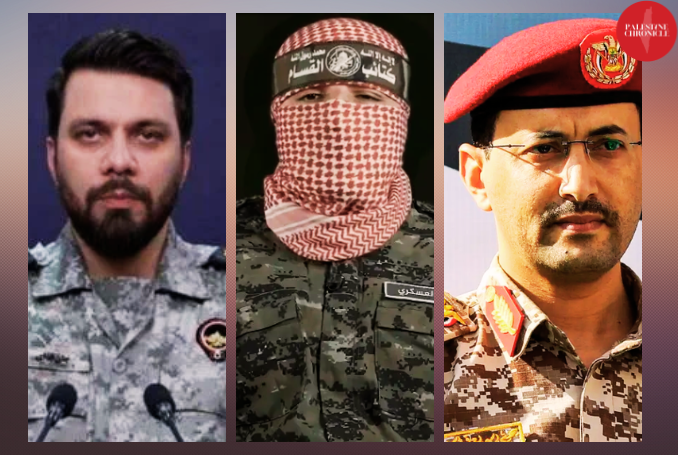
Ibrahim Zolfaghari, Abu Obeida, and Yahya Saree. (Photos: video grab. Design: Palestine Chronicle)

From Gaza to Yemen to Iran, military spokesmen have emerged as central figures in a transformed, unified battlefield.

The current phase of war in the Middle East has not only redrawn military maps—it has redefined how war itself is articulated, perceived, and embodied.

What was once described as the “unity of squares – has evolved into something far more concrete: a ‘unity of battlefields’.

Overlapping conflicts have driven this transformation—the ongoing genocide in Gaza, the widening regional confrontations, and most decisively, the US-Israeli aggression on Iran beginning February 28.

The result is not merely coordination. It is simultaneity: Missiles launched from Yemen align with operations in Lebanon. Statements issued in Tehran echo those emerging from Gaza. Military timelines intersect, narratives converge, and the war begins to function as a single, interconnected space.

This shift—from conceptual alignment to tangible, synchronized warfare—has also produced a parallel transformation: the emergence of new kinds of figures who represent this war.

People’s Voices

One layer of this transformation is rooted in the visibility of ordinary people.

Across Gaza, Yemen, Lebanon, and Iran, men, women, and children have produced some of the most powerful and widely circulated narratives of the war. Their testimonies—often recorded in real time—have reshaped how events are understood, bypassing traditional media structures.

These voices have become iconic in their own right.  They reassert a fundamental principle: that history is not only written by institutions or states, but also articulated by people themselves.

Through social media, these individuals have turned lived experience into political discourse, often reaching audiences far beyond their immediate surroundings.

But while these voices are central, they exist alongside another, more structured phenomenon.

The Spokesman

At the forefront of this second layer stand military spokesmen.

Figures such as Abu Obeida in Gaza, Ibrahim Zolfaghari in Iran, and Yahya Saree of Ansarallah in Yemen have moved far beyond their formal roles as conveyors of information.

They do not simply announce operations. They embody them.

Each appearance is not just a briefing—it is an event. Each statement is not merely descriptive—it is performative, strategic, and deeply embedded in the broader logic of the war.

Their tone, language, timing, and even physical presence form part of the battlefield itself.

When Abu Obeida declared that “the shortest way to liberate the prisoners is through resistance,” he was not simply making a tactical argument, but reaffirming a long-standing doctrine that places armed struggle at the center of political outcomes.

When Yahya Saree repeatedly emphasized that operations “will continue”, he was not merely describing military continuity, but situating Yemen within an expanding, unified confrontation that stretches beyond its borders.

And when Ibrahim Zolfaghari addressed US forces directly, warning that they could become “food for the sharks of the Persian Gulf,” he was projecting a language of deterrence that bypasses mediation and speaks directly to adversaries in their own political and psychological space.

Each of these statements operates beyond information. It is a signal.

Iconic Presence

What distinguishes these figures is not only what they say, but how they are received.

Abu Obeida, the military spokesman of Al-Qassam Brigades, has become one of the most recognizable figures associated with the Palestinian resistance. His carefully structured statements, delivered with consistency and clarity, resonate far beyond Gaza.

Yahya Saree, speaking on behalf of Yemen’s Ansarallah, has similarly established a steady presence, announcing operations that are explicitly framed within a broader regional alignment.

In Iran, Ibrahim Zolfaghari has introduced a different dimension—multilingual communication that directly addresses multiple audiences, including Israeli society itself, collapsing linguistic distance and reinforcing psychological impact.

Their words travel instantly. Their tone is studied. Their pauses, repetitions, and formulations become recognizable patterns.

They are quoted, clipped, translated, and redistributed across platforms.

Their presence generates expectation.

Their absence raises questions.

Beyond Individual

Perhaps the most striking aspect of this phenomenon is that it does not depend on the individual alone.

Following the assassination of Abu Obeida, a new figure emerged under the same name—continuing the role with remarkable continuity in tone, cadence, and presence. The transition was seamless.

Nothing essential changed. This continuity suggests that Abu Obeida is no longer merely a person. He is a constructed presence, sustained by a broader institutional and cultural framework.

A voice that can be reproduced. A figure that can be reinhabited. The same applies, in different ways, to Saree and Zolfaghari. They function not only as individuals, but as expressions of a collective identity.

Language as Power

Central to this transformation is the role of language. These spokesmen do not simply communicate facts. They structure meaning.

Abu Obeida consistently frames resistance as the decisive factor in shaping outcomes, linking battlefield action to political consequence.

Saree situates Yemeni operations within a wider geography of solidarity, where each strike is part of a broader moral and strategic framework.

Zolfaghari, in turn, employs direct, often multilingual messaging that collapses the distance between speaker and audience, reinforcing the immediacy of the confrontation.

Language, in this context, becomes a form of action. It shapes perception, influences morale, and contributes to the overall conduct of the war.

The New Role

The evolution of these figures reflects a broader shift in the role of the military spokesman.

Traditionally, the spokesman was a mediator—someone who translated battlefield developments into public information. Today, that role has expanded significantly.

The spokesman is now a strategic actor.

His presence carries weight beyond the content of his statements. His credibility, tone, and consistency contribute to shaping how the war is understood, both regionally and globally.

A Collective Symbol

Ultimately, the significance of figures like Abu Obeida, Zolfaghari, and Saree lies in what they represent. They are not isolated personalities. They are part of a wider phenomenon that reflects the convergence of battlefields, narratives, and public perception.

In a moment defined by fragmentation, they provide continuity. In a landscape shaped by competing narratives, they offer a consistent voice.

And in a war that spans multiple fronts, they embody the idea that those fronts are no longer separate.

They are one.

(The Palestine Chronicle)

A New Resistance Front: How Does Syria Factor into the Regional War?

By Robert Inlakesh

How does Syria factor in the regional war? (Map: via social media)

Two sources familiar with the matter informed Palestine Chronicle that the quantity of weapons flowing through the Syrian-Lebanese border had even increased since the fall of Bashar al-Assad.

A new Syrian resistance group has emerged and is the only organization in the country currently carrying out offensive actions against both Israeli and US targets. This development comes as Israel uses the newly occupied territories in its ground assault on Lebanon, a move that could easily rope Tel Aviv into a new quagmire.

While a US allied leader now technically controls Damascus, the reality on the ground in Syria is that there is no functional State. This being the case, the outbreak of chaos is simply one miscalculation away.

In stark contrast to the regimented and tightly controlled Syria that existed under the rule of Bashar Al-Assad and his father Hafez al-Assad, the country today is divided between countless powers throughout the country, with the President functioning as less of a strongman and more of a symbolic figure that covers the explosive charges ready to detonate. Nowhere was this on clearer display than in the July 2025 clashes in southern Syria’s Sweida Province.

President Ahmed al-Shara’a, also known as Abu Mohammed al-Jolani, has allied himself with his Western backers and even gone as far as signing onto a normalization mechanism with Israel. Short of full normalization of ties with Tel Aviv, the “joint fusion mechanism” that was agreed upon by Syrian and Israeli officials seeks to “facilitate immediate and ongoing coordination on their intelligence sharing, military de-escalation, diplomatic engagement, and commercial opportunities under the supervision of the United States.”

Knowing this, it would therefore appear strange that the Israelis still persist with not only bombing Syrian civilian infrastructure across the country, but also Syria’s new military forces. Understanding why will help in unlocking what appears on the surface to be a difficult puzzle to solve.

The Syrian leadership is Hayat Tahrir al-Sham (HTS), infamous for being a rebrand of al-Nusra Front (Al-Qaeda in Syria). Although it is presented as if it were a real government, the group never had any experience in governance. Instead, they knew only how to rule over smaller militia factions and worked as the de facto leadership in Idlib, despite there having been a “Syrian Salvation Government” (SSG) who were technically in control of the territory.

Prior to the fall of Bashar al-Assad’s leadership in December of 2024, HTS had consented to the SSG’s existence in order to give the veneer of a professionally organized opposition. In reality, HTS held all the power cards, even running its own secret prisons, while leaving the administrative details to be hashed out by the professionals. 

All of this is of great importance because Bashar al-Assad’s entire system was not overthrown in some kind of war of liberation; instead, it collapsed without any real fight. Therefore, when Ahmed al-Shara’a entered Damascus and declared himself leader, he was in a very difficult position.

Under the supervision of his foreign backers, chiefly the United States, the new Syrian leadership focused on symbolism rather than fundamentally changing the way the country functioned. Therefore, Damascus opened itself up to Washington and became a playground for Western and Israeli intelligence agents, as the new President attempted to impress Washington.

Meanwhile, many of the most corrupt elements belonging to the former regime, were permitted to continue on as if it was business as usual, all as the Syrian Arab Army (SAA) and former intelligence and police services were disbanded. What replaced the former security apparatus were simply militants belonging to the alphabet soup of Al-Qaeda affiliates that had been operating previously out of Idlib.

This being the case, the words of Ahmed al-Shara’a often have little to no bearing on what actually transpires on the ground. Meaning that corruption is rampant, every corner of the nation is filled with different armed forces who have their own territory when push comes to shove. In essence, all of Syria became a big Idlib.

Syria is no longer subjected to sanctions, has gained access to its most fertile agricultural lands, is no longer internationally isolated, while ruling over its own oil and gas fields. Despite all of this, the country’s economy is still in the toilet, and the long-promised prosperity has been reduced to vague future visions. This isn’t to say it’s impossible for things to change, but as it stands, this is Syria today.

Because of the state of Syria’s affairs, cross-border smuggling has exploded and this has evidently benefited Lebanese Hezbollah next door. Two sources familiar with the matter informed Palestine Chronicle that the quantity of weapons flowing through the Syrian-Lebanese border had even increased since the fall of Bashar al-Assad.

According to reports, the US has been applying pressure on Damascus to attack Lebanon in order to help Israel weaken Hezbollah in the Bekaa Valley region. In response, President al-Shara’a broke his silence this Tuesday and declared that Syria will not attack Lebanon, an announcement that came following a threat earlier that day from an Iraqi Popular Mobilization Units (PMU) spokesperson, threatening to attack if Damascus orders such a move.

This affirmed previous suspicions that such an equation could arise, whereby a Syrian invasion of Lebanon would trigger an Iraqi invasion. The PMU, when fully mobilized, can muster a force of around 250,000 fighters, a much more formidable force than what currently constitutes the Syrian Army.

Another possible equation that could be set is a Syria-Israel clash. Not only could armed resistance groups, aligned with the Iranian-led Axis of Resistance, end up creating such a reality, but others could also be roped in.

Israel’s recent bombing of Syrian military positions, coupled with Israeli Security Minister Itamar Ben Gvir’s calls to assassinate the Syrian President, both occurred following an alleged military buildup near the Sweida Province.

It is likely that Damascus was eyeing the opportunity presenting itself to finally deal with the Druze Separatist movement in the southern province. Led by one of the Druze minority group’s spiritual leaders, Hikmat al-Hijri, a unified command calling itself the “National Guard” formed in order to operate a semi-autonomous zone in Sweida.

The National Guard began receiving direct military, financial and logistical support from Israel, who have long sought to establish a Druze rump State in southern Syria, a goal that enables an even greater land grab, as well as opening up “David’s Corridor” spanning over to the Iraqi-Syrian border. 

In the eyes of Syria’s leadership, the Druze issue is of great importance to solve for a range of reasons. One of which is that there is an enormous amount of sectarian tension, which various groups who form the new Syrian security apparatus, along with the Bedouin tribal forces, seek to punish following the bloodshed that began last July. It will also mean that technically, Syria will be one step closer to having one central government rule the entire country, which is a symbolic victory for Ahmed al-Shara’a.

However, the Israelis appear to have pre-empted such an offensive and committed a number of airstrikes as a warning to the Syrian leadership. There is clear anxiety over such a battle unfolding, because if it occurs, the Israeli military will be forced to intervene in order to save its Druze separatist allies.

As mentioned above, if things spiral out of control, the President himself cannot necessarily do much about it. That means that Syrian forces will likely begin to directly come into contact with the Israelis on the ground, something that could easily spiral.

Most of the fighters who have, for now, aligned themselves with the Syrian government are no fans of Israel, to say the least. This was on full display last December during the military parades conducted by Syria’s new armed forces, who openly chanted for Gaza, threatened Tel Aviv, and some even burned Israeli flags.

The alternative scenario for the Israelis in Syria may end up being worse, meaning that if they were to assassinate al-Shara’a, a power struggle would likely end up playing out on the streets of the Capital and throughout the country. So many different actors will seek to claim power.

Syria’s predicament has turned out to be less favourable to Tel Aviv, not because it poses an immediate strategic threat, but because almost anything is possible there. During the regional war between the Israeli-US alliance and the Iranian-led Axis of Resistance, one wrong misstep could prove fatal and open up yet another front, which will not only drain their resources but also weaken their ability to fight Hezbollah.

– Robert Inlakesh is a journalist, writer, and documentary filmmaker. He focuses on the Middle East, specializing in Palestine. He contributed this article to The Palestine Chronicle.

Iran: East of Suez, West of Hormuz? The Question That Will Define the Next Era

 By Jeremy Salt

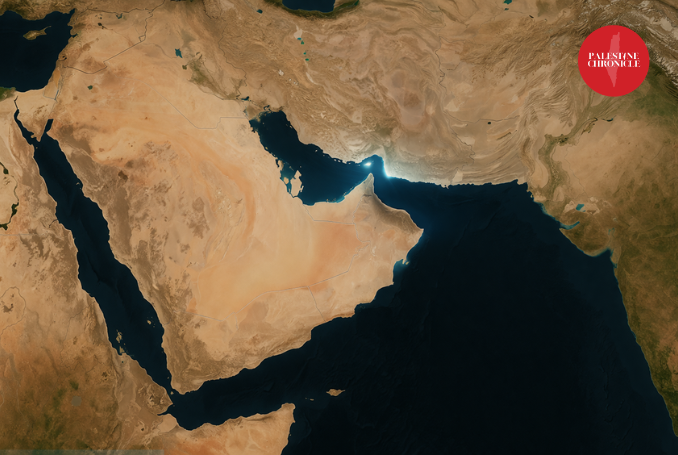
The Strait of Hormuz is a critical chokepoint through which around 20 million barrels of oil pass daily. (Photo Illustration: PC)

Will ‘west of Hormuz’ share historical space with ‘east of Suez’ as a defining act that changed the balance of global power? The answers to these and other questions should not be long in coming.

In February 1960, the British Prime Minister, Harold MacMillan, made an historic speech in the South African parliament. “The wind of change is blowing through the continent,” he said. “Whether we like it or not, the growth of national conscience is a fact.” He did not say it outright, but apartheid was unacceptable to the British government, which had in fact accepted it since it was officially declared in 1948. In the future, the UK would not stand in the way of independence movements.

Of course, it did, and he was only talking about the African continent anyway and not the Middle East, where, in 1956, the US had humiliated the UK by forcing it to end the ‘tripartite aggression’ launched against Egypt in collaboration with France and Israel only ten days earlier.

In 1946, the UK had declared its intention to withdraw from Palestine, not out of the goodness of its heart but because it could no longer afford to stay there. It was pulling out of India and other colonial possessions for the same reason.

World War Two had left it virtually bankrupt and dependent on US financial aid. Empire was a luxury it could no longer afford.

In 1960, the devaluation of the pound was the trigger for the declaration by then Prime Minister Harold Wilson and defence minister Denis Healey that British troops would be withdrawn from bases ‘east of Aden,’ which had been in British hands since 1839. Basically, they were referring to the bases in Malaya (Malaysia) and Singapore, but those in the Persian Gulf were also included.

In time ‘east of Aden’ was taken to mean the closure of all military bases ‘east of Suez.’

However, while the British lion had lost its teeth, it had not lost its appetite and was never going to accept the loss of status as a great power.

As Anthony Eden, the prime minister at the time of the Suez war, had remarked, he would rather go to war than allow Britain to be reduced to the level of second-rate countries like Portugal or the Netherlands. He did go to war, and was humiliated.

In fact, the British never withdrew ‘east of Suez’ and never intended to. It dominated the Persian Gulf in the 19th century, occupying Aden in 1839 and maintaining its grip through subsidized tribal shaikhs who headed the ‘Trucial States’. In 1971 Britain relinquished its control of foreign policy and these states became independent, if only in name, as the UAE (United Arab Emirates).

Oman, Kuwait, and Bahrain remained outside this arrangement but remain tied militarily either to the US or the UK. The UK had a naval base in Bahrain from 1935. In 1971, it was taken over by the US, but in 2014, the UK established a permanent naval base ‘east of Suez’ at Mina (port) Salman in Bahrain. In 2024, it opened an air base at Al Minhad, close to Dubai in the UAE.

The US and the UK share a military base on the island of Diego Garcia in the Indian Ocean Chagos Islands. From 1968-1973, the inhabitants of the entire Chagos archipelago were forcefully removed so these two governments could use their homes as a launching pad for war.

In the Mediterranean, ‘east of Suez’ never applied to Cyprus, snitched from the Ottoman government in 1878 in return for a pledge to defend the Ottomans in the event of an attack by Russia and maintained as a military base ever since. In 1914, the Ottoman Empire was attacked by Russia, but by then Britain was its ally. It ruled Cyprus until its independence in 1960.

In the past two years, the RAF base at Akrotiri in Greek Cyprus has been used for regular surveillance flights over Gaza to help Israel. Israeli troops were training in Cyprus several years ago because its mountainous terrain is similar to that of southern Lebanon.

Where all of this dovetails into the war on Iran is that the Iranian government has demanded a full US withdrawal from the Persian Gulf as one of its conditions for ending the war. This would have to imply a UK withdrawal as well. What Iran wants is an end to the entire western military presence, and a withdrawal ‘west of Hormuz’ that would be the parallel to the withdrawal ‘east of Suez.’

In fact, the UK never fully withdrew ‘east of Suez’ and it is even less likely that the US would agree to Iran’s demand that it withdraw ‘west of Hormuz.’ Empires don’t go down without a fight. Withdrawal ‘west of Hormuz’ would not be existential for the US as a country, but it would be for the collective ‘west.’

For half a millennium, every ‘western’ empire has had its turn in raping the east through war, intimidation and economic exploitation. Britain, France, Spain, Italy, Portugal and the Netherlands all jumped in for their chop over the past five hundred years before being forced to retreat and settle for comfortable late empire retirement.

Now the US seems close to the end of its run, which is why, of all the demands made by Iran, withdrawal ‘west of Hormuz’ is non-negotiable for the US. Retreat would be the acceptance of defeat.

It would push an already tottering American empire off its plinth. Furthermore, the last gasp on the deathbed of ‘western’ global domination would almost be audible. No one would be left with the will or the power to pick up the fallen American banner.

Yet this demand is non-negotiable for Iran as well. Nearly 50 years have passed and it cannot live any longer at the point of the ‘western’ sword.

This epochal moment in history compares with Suez and no doubt many other occasions in history as the long run of the powerful approaches its end.

In the past several weeks, Trump has offered terms that are not subject to negotiations because they are an ultimatum. ‘Accept these terms or we will obliterate you.’ This is a scarcely veiled variation of the Mafia ‘offer you can’t refuse’ and what puzzles Trump is that Iran is not accepting.

Having started this war, Trump, behind the bluster, seems to want to get out of it, but does not know how. A large part of his problem is that Israel wants the war to continue, with the full support of the US, because without it, Israel cannot continue the fight. Its strong advantage is the Zionist billionaires who fund Trump and a Congress bribed and bought out long ago by the Israel lobby.

There seems no negotiated way out but sooner or later, under the accumulating pressure, something has to give way.
The wild card in the pack, of course, is Israel. It does not want the war to end, not just until the Islamic government is destroyed but until Iran is either broken up into ethno-national statelets or returned to the slave status that lasted until 1979.

This goes beyond what the US thinks is feasible, at least what sound military and strategic minds think is feasible. The truth seems to be dawning on Trump, but he is impaled on Israel’s hook and Israel is not going to let him wriggle off it. This is his own fault. He made his own pact with the devil long ago and now the billionaire Zionists who funded him all the way into the White House are calling in the debt.

The Islamic Republic of Iran was never an existential threat to Israel. Its opposition was based on principled legal and moral support for the Palestinians. Had the Palestinians ever been offered a judicious settlement, and had they accepted it, Iran would have accepted it, too, but such an offer was never made.

Israel was never going to share what it had stolen. It always wanted more. Its road to ‘peace’ was genocidal force against the Palestinians and anyone who would dare stand against it.

That policy has now completely unravelled. Its own military-strategic decline began long ago. Over-extended militarily at several levels, it has now finally started a war that has bounced back in its own large-scale destruction.

Both Yemen and Hezbollah have joined the war. The destruction of scores of Merkava tanks in southern Lebanon is unprecedented. Israel’s own chief of staff says the military is exhausted and suffering a manpower shortage so acute it is at risk of “collapsing in on itself.”

This is a scare attack designed to bring into the army those avoiding military service. At the same time, there is no doubt that the military is overstretched. The ‘existential threat’ Israel has always used as a pretext for its wars is now real, but brought on by Israel itself.

Trump’s public standing in the US is fast heading to rock bottom. Narcissistic, blaming everyone else for his own folly, turning on European allies who are rapidly turning against him, can Trump somehow resist being pulled deeper into the vortex by Israel, and if he can, what will Israel do then?

Or is he still fully onside with Israel, with his talk of negotiations and maybe ‘walking away’ from the Strait of Hormuz a ruse giving him time to marshal US forces ahead of a land attack on Iran intended to seize strategic territory?

Will ‘west of Hormuz’ share historical space with ‘east of Suez’ as a defining act that changed the balance of global power? The answers to these and other questions should not be long in coming.

– Jeremy Salt taught at the University of Melbourne, at Bosporus University in Istanbul and Bilkent University in Ankara for many years, specializing in the modern history of the Middle East. Among his recent publications is his 2008 book, The Unmaking of the Middle East. A History of Western Disorder in Arab Lands (University of California Press) and The Last Ottoman Wars. The Human Cost 1877-1923 (University of Utah Press, 2019). He contributed this article to The Palestine Chronicle.