
By Ranjan Solomon
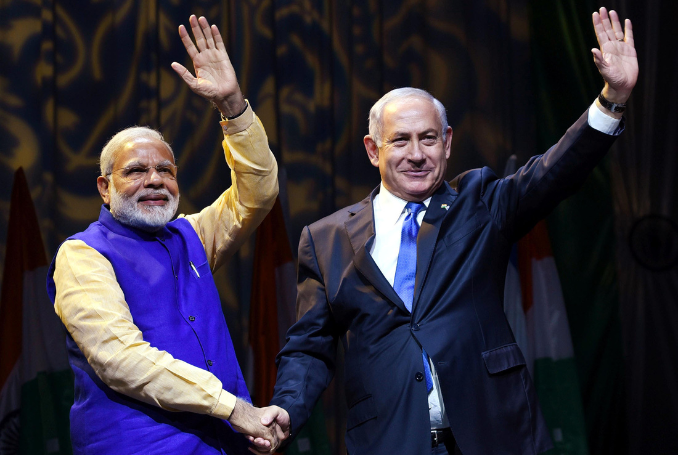 Indian Prime Minister Narendra Modi and Israeli Prime Minister Benjamin Netanyahu. (Photo: Indian PM Office, via Wikimedia Commons)
This agreement, if signed, will not be remembered for tariff schedules or export volumes. It will be remembered as a choice made while Gaza burned.
As India advances negotiations for a Free Trade Agreement (FTA) with Israel, the question that ought to dominate public debate is not how much trade will increase or which sectors will benefit. It is a more fundamental question: what does it mean for a constitutional democracy to deepen economic integration with a state accused by leading human rights organizations, UN experts, and international jurists of apartheid, war crimes, and genocide?
Trade agreements are never neutral instruments. They are political documents, moral signals, and strategic commitments rolled into legal form. In the case of India and Israel, the proposed FTA is not an isolated economic exercise but the logical culmination of a relationship that has been carefully normalized over three decades—across defense, surveillance, agriculture, internal security, cyber technologies, and tourism.
What the FTA threatens to do is to formalize, legalize, and insulate this relationship at precisely the moment when Israel stands accused of some of the gravest crimes of the 21st century in Gaza.
India’s official rhetoric cloaks these negotiations in the language of “innovation”, “technology transfer”, and “mutual benefit”. But such framing deliberately obscures a central reality: Israel’s economy is inseparable from its occupation economy. Its expertise in water management, agri-tech, border control, surveillance, and urban security has been developed through decades of military domination, land confiscation, collective punishment, and population control of Palestinians. To trade in these technologies is not to engage in neutral exchange; it is to participate in the circulation of knowledge and systems refined through oppression.
What makes India’s engagement particularly troubling is its scale, diffusion, and quietness. While foreign policy is constitutionally a Union subject, Israel has embedded itself deeply into India through a web of state-level Memoranda of Understanding. Across numerous states—BJP-ruled and non-BJP alike—agreements have been signed in agriculture, water management, policing, homeland security, cyber systems, urban governance, and tourism promotion.
This federal dispersion is not incidental. It fragments accountability, bypasses parliamentary scrutiny, and normalizes Israel as a routine development partner, rather than a deeply contested political actor implicated in systematic violence.
India-Israel Collaboration: Agriculture to Security
Agriculture has been one of the most visible entry points towards developing the FTA. Israeli “Centers of Excellence” dot several states, showcasing drip irrigation, precision farming, seed technologies, and controlled-environment agriculture. These initiatives are presented as solutions to India’s agrarian crisis.
What remains unspoken is that many of these technologies were perfected on occupied Palestinian land, where Israel controls aquifers, rations water, uproots orchards, and weaponizes scarcity. When Indian states import these models uncritically, they also import a logic that divorces efficiency from justice and innovation from the conditions under which it was produced.
Security cooperation is even more disturbing. Israeli firms are deeply embedded in India’s defense procurement, police modernization, and internal security architecture. Drones, surveillance systems, crowd-control tools, facial recognition technologies, and cyber capabilities increasingly migrate from military use to civilian policing.
These tools are marketed as “battle-tested”—a euphemism that conceals the fact that they have been tested on a captive civilian population living under occupation. As India experiences the steady militarization of governance and the erosion of civil liberties, the convergence with Israeli security doctrine is not coincidental; it is structural.
This convergence became unmistakable with the exposure of Israeli spyware operating illegally in India. The Pegasus spyware scandal revealed how Israeli cyber weapons were deployed to surveil journalists, opposition leaders, human rights defenders, lawyers, activists, and even members of the judiciary. Investigations by the Pegasus Project—coordinated by Forbidden Stories and Amnesty International’s Security Lab—provided forensic evidence of infections on Indian devices. NSO Group, the Israeli company behind Pegasus, has repeatedly stated that its spyware is sold only to “authorized governments,” making state involvement unavoidable.
The Indian government has neither denied nor confirmed its use, hiding behind the language of national security. The Supreme Court of India, unconvinced by this evasion, constituted an independent technical committee. The committee confirmed the presence of malware on several devices and strongly criticized the Union government for its lack of cooperation.
This is not conjecture or activist exaggeration; it is a matter of judicial record. That such surveillance tools originate in Israel’s cyber-security industry—honed through decades of monitoring Palestinians—should alarm anyone concerned with democracy. An FTA that deepens technology and cyber cooperation risks legitimizing an ecosystem already used to undermine constitutional freedoms from within.
Tourism and cultural exchanges play a quieter but equally insidious role. Joint tourism promotions, hospitality partnerships, and destination branding initiatives involving Indian states help launder Israel’s global image. A state under investigation at the International Court of Justice is repackaged as a benign hub of beaches, spirituality, and innovation.
This soft normalization complements hard security and economic ties, creating a sense of inevitability around partnership while erasing the political context that makes such a partnership morally indefensible.
A Betrayal of Indian Anti-Colonial Struggle
It is within this already saturated landscape that the proposed FTA must be understood. By the time such an agreement is signed, Israel will already be present in India’s farms, police stations, data systems, surveillance networks, and tourism boards. The FTA does not initiate the relationship; it locks it in, converting political choices into binding legal obligations. Trade agreements are designed to outlast governments and outmaneuver public dissent. They make disengagement expensive and ethical reconsideration inconvenient.
The timing of these negotiations is therefore impossible to separate from Gaza. As Palestinians face mass displacement, starvation, and systematic bombardment, the world is being forced to choose between accountability and complicity. Many states have been compelled—by public pressure, if not moral conviction—to reassess their ties with Israel. India has chosen the opposite path: deepening engagement while suppressing solidarity at home. Pro-Palestine protests have been denied permission, students intimidated, activists detained, and public expression chilled. The message is clear: economic partnership abroad requires political silence at home.
Yet the story does not end with states and corporations. Across India, people’s movements—students, writers, trade unions, farmers’ collectives, women’s groups, cultural workers, and faith-based organizations—have refused to accept Israel’s sanitization as a “normal” partner. Despite prohibitory orders, surveillance, and intimidation, solidarity with Palestine has emerged on campuses, in workers’ meetings, cultural spaces, and digital forums. These are not fringe acts of dissent; they represent a moral counter-current that challenges the state’s alignment with militarized power.
The repression of these movements—police notices, detentions, cancelled permissions, public vilification—reveals what is truly at stake. Trade with Israel is not merely external policy; it demands internal conformity. It requires citizens to forget Gaza, ignore apartheid, and accept surveillance as governance. That people continue to resist despite these pressures is a reminder that moral politics in India has not vanished—it has been pushed outside official discourse.
Supporters of the FTA insist that trade must be insulated from politics and that national interest demands pragmatism. This argument collapses on contact with reality. India has never treated trade as morally neutral. It has used sanctions, boycotts, and preferential agreements to signal political positions in the past. To invoke neutrality now is not pragmatism; it is selective ethics, deployed precisely when moral clarity is most required.
Nor is it convincing to claim that the FTA will primarily benefit ordinary Indians. Trade liberalization overwhelmingly serves large corporations, defense contractors, and technology firms, while farmers, workers, and small producers absorb the costs. When such benefits are tied to an occupational economy, the moral deficit becomes indefensible.
India’s own history makes this moment particularly stark. Emerging from colonialism through a struggle that combined political resistance with ethical imagination, India once spoke with authority on occupation and self-determination. Alignment with Israel—especially at this historical juncture—signals not strength but abandonment: an abandonment of principles that once distinguished India globally.
An FTA with Israel is not just a trade document. It is a declaration of alignment, ethical, political, and historical. Governments may sign agreements, but history listens to people. It remembers those who resisted apartheid when it was profitable, who opposed colonialism when it was legal, and who stood with Palestine when silence was rewarded. India’s people’s movements today stand closer to the country’s anti-colonial legacy than its trade negotiators do.
This agreement, if signed, will not be remembered for tariff schedules or export volumes. It will be remembered as a choice—made while Gaza burned, while surveillance turned inward, and while dissent was criminalized. The question is no longer whether India can afford to delay this FTA. It is whether it can afford the moral cost of proceeding.
(The Palestine Chronicle)

– Ranjan Solomon has been a long-time advocate for justice and an independent state for Palestine. He contributed this article to the Palestine Chronicle.
No comments:
Post a Comment