
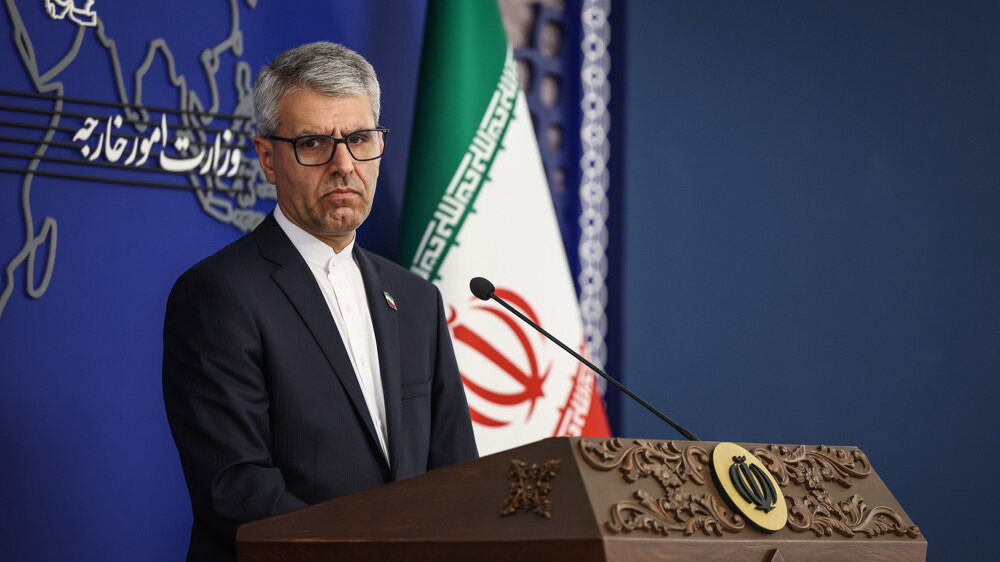
TEHRAN – Iran says the circumstances are not yet ripe for launching negotiations with the United States despite Iran’s commitment to diplomacy, Foreign Ministry spokesperson Esmaeil Baqaei said on Monday, amid reports that Iraq has offered to mediate between Tehran and Washington.
Baqaei said Iran appreciates Baghdad’s concern for regional stability, but stressed that any negotiation process would require all parties to respect the basic norms of diplomacy, particularly in light of developments over the past several months.
He noted Washington’s use of diplomacy as cover during the most recent round of indirect talks, claiming that the process helped pave the way for Israeli-American attacks on Iran.
“So long as this prerequisite is not met,” he said, “talk of launching a negotiation process is not particularly realistic.”
Baqaei added, however, that Tehran remains committed to diplomacy and would not hesitate to pursue it whenever it determines negotiations can be effective.
For nearly two decades, Iran's peaceful nuclear program has been met with relentless opposition from the West. Pressure came in many forms, endless negotiations that went nowhere, punishing sanctions and even military aggression.
When the United States struck Iranian nuclear sites during the illegal U.S.-Israeli military aggression in June, the European trio, France, Germany and Britain, stepped in with their own strategy, activating the so-called snapback mechanism.
"Snapback" was a mechanism under UN Security Council Resolution 2231, designed to automatically reinstate UN sanctions against Iran if it violated the terms of the JCPOA, a nuclear agreement signed by Iran, the U.S., UK, France, Germany, Russia, and China in 2015. Under its terms, Iran committed to limiting its nuclear program in return for sanctions relief. However, the U.S. unilaterally withdrew from the deal and re-imposed sanctions in 2018. European signatories said Iran must continue adhering to the JCPOA, despite their inability to compel Washington's return or mitigate the debilitating impact of its sanctions.
‘Israel’s recognition of Somaliland is fundamentally baseless’
Baqaei also criticized Israel’s announcement that it had recognized Somaliland, calling the move “fundamentally baseless and meaningless” and part of a broader strategy aimed at destabilizing the region.
He said no country or international institution had endorsed the move and argued that recognizing a self-declared entity within Somalia amounted to interference in the territorial integrity of an independent state, with no legal or political basis.
He described the decision as an attempt by an illegitimate regime to fragment Muslim countries, accelerate regional disintegration, and leave the region more vulnerable to Israeli ambitions and acts of aggression.
Baqaei pointed to statements issued by the Organization of Islamic Cooperation (OIC), the Arab League, and the African Union, all of which, he said, have explicitly rejected the so-called recognition.
He added that the move has no standing under the UN system or international law, particularly in relation to principles of sovereignty and territorial integrity.
According to Baqaei, the issue goes beyond an attempt to separate part of a Muslim country and reflects a wider strategy aimed at destabilizing a broad geographic area spanning West Asia, the Horn of Africa, and the Red Sea.
He said he hoped the development would serve as a warning to countries in the region and beyond, arguing that Israel’s actions are “inherently anti-peace” and designed to fuel division, tension, and conflict.
Israel announced on Friday that it had recognized the self-declared Republic of Somaliland as a “sovereign state,” prompting international criticism.
‘Israel seeks a defenseless region’
Baqaei also said Israel seeks a “defenseless” region, but claimed regional states are increasingly aligned on the view that lasting peace and stability depend on restraining the Zionist regime.
Asked about reports that Israeli Prime Minister Benjamin Netanyahu may present U.S. President Donald Trump with a new plan for attacking Iran during an upcoming White House meeting, Baqaei said Tehran would not be swayed by psychological warfare and added that Iran’s armed forces remain focused on strengthening their capabilities.
“With the support of the Iranian nation, we will, God willing, overcome any challenge,” he said, adding that Iran’s strength is rooted in its people and domestic resources.
Iran denies reports of diplomats leaving Venezuela
Baqaei rejected reports claiming Iranian diplomats had left Venezuela, saying the ambassador and embassy staff remain in place and continue to carry out their duties.
“Our embassy is very active,” he said, describing the reports as part of what he called an ongoing psychological campaign against Iran.
‘Yemen’s unity remains a principle for Iran’
Baqaei reiterated that Iran considers Yemen’s territorial integrity and unity a core principle, warning that any process undermining Yemen’s unity would serve Israel’s interests and threaten regional security.
He stressed the importance of intra-Yemeni dialogue in stabilizing the country and said Iran would not withhold support that could help facilitate such engagement.
‘Iran’s support for One-China principle is unwavering’
Commenting on recent U.S. arms sales to Taiwan, Baqaei said Iran’s position remains firmly aligned with the One-China principle, which he said Washington’s move had violated.
He said Iran will not change this stance “under any circumstances,” arguing that U.S. actions fuel regional tensions and escalation rather than stability.
‘Ties with Russia not aimed at third parties’
On Ukrainian statements acknowledging that Kyiv has no evidence Iran helped produce missiles for Russia, Baqaei said this had already been stated by Ukraine’s president months earlier.
He said Iran’s relationship with Russia is longstanding, based on mutual interests and respect, and is not directed against any third country
No comments:
Post a Comment