
By staff writer
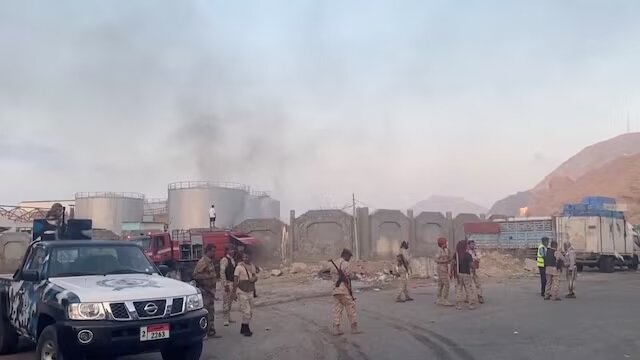
TEHRAN – Saudi Arabia has framed its national security as a “red line,” warning it will act decisively against any foreign military support for separatist groups in Yemen. The declaration on Tuesday came hours after Saudi-led coalition airstrikes targeted vehicles and cargo at Mukalla port, which Riyadh said had been supplied by the United Arab Emirates to the Southern Transitional Council (STC). Though the strike was limited and caused no casualties, its political significance was profound: Saudi Arabia is signaling that Abu Dhabi’s maneuvers have crossed into confrontation.
Rashad al Alimi, the Saudi-backed head of Yemen’s Presidential Leadership Council, reinforced this position in a televised address. He ordered all Emirati forces to leave Yemen within 24 hours, cancelled the defense pact with Abu Dhabi, declared a 90-day state of emergency, and imposed a 72-hour blockade on ports and border crossings. His response underscored Riyadh’s determination to reassert control over the coalition’s agenda and to confront what it views as destabilizing Emirati ambitions.
This escalation highlights the diverging strategies of the two Persian Gulf Arab countries. Saudi Arabia has consistently sought to preserve Yemen’s territorial cohesion, viewing unity as essential to regional stability and to any eventual negotiated settlement. The UAE, by contrast, has increasingly backed separatist forces in the south, using the STC as a vehicle for influence and expanding into provinces such as Hadramout and al Mahra. For Riyadh, these moves undermine coalition authority and threaten its strategic depth.
The UAE’s involvement in Yemen is part of a broader expansionist project. By entrenching itself in ports such as Aden, Mukalla, and Socotra, Abu Dhabi aims to control maritime chokepoints and project power across the Red Sea and Horn of Africa. Its silence on Israel’s recognition of Somaliland further illustrates how its ambitions align with Tel Aviv, deepening cooperation since the Abraham Accords. From Saudi Arabia’s perspective, this is not a benign strategy but encirclement, a tightening ring of influence that jeopardizes its security.
Similar patterns can be seen elsewhere. In Sudan, the UAE has been accused of backing the Rapid Support Forces, empowering armed factions to secure leverage even at the cost of prolonged instability. This reliance on proxies, combined with port control and external alignments, reveals a doctrine of opportunistic expansionism that destabilizes fragile states.
Saudi Arabia’s latest warning is therefore more than a reaction to Mukalla. It signals that Abu Dhabi’s maneuvers have crossed a threshold. The confrontation is not simply about Yemen’s battlefield but about who will shape the balance of power in the Persian Gulf and the wider Middle East. By arming separatists and pursuing control of strategic ports, the UAE has shifted from partnership to destabilization. Riyadh’s firm stance marks a decisive moment in curbing Abu Dhabi’s ambitions and defining the boundaries of acceptable power in the region — an action likely to influence the political trajectory of the Persian Gulf Arab bloc for years to come.
No comments:
Post a Comment