
IQNA – An Iraqi Shia scholar believes that new studies on the origin of the name Buratha (son of wonders) and the mysterious stones of the historic Buratha Mosque in Iraq strengthen the theory that the birthplace of Jesus (AS) was not in Bethlehem, but in Iraq.
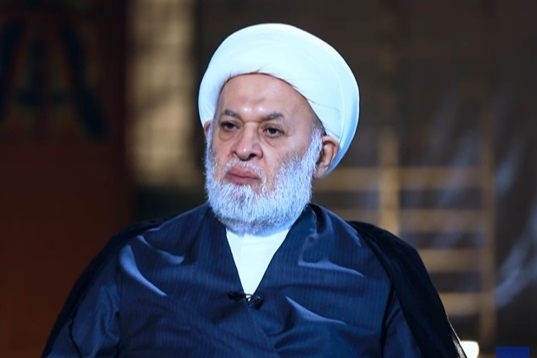
Sheikh Jalaluddin Sagheer wrote this in an article, saying it is a view that is more consistent with Quranic evidence and Shia narratives.
The prominent Shia scholar wrote the article in response to a question about the birthplace of Jesus Christ (AS), saying that, unfortunately, many Islamic scholars have ignored the geographical data provided in the Holy Quran regarding the birthplace of Prophet Jesus (AS), and many of them have been content with Christian narratives in this regard.
Following are excerpts from his article:
When describing the birth of Jesus (AS), the Quran speaks of palm trees and fresh dates, but Palestine in general and Bethlehem in particular did not have any palm trees at that time.
It can be said that the first palm tree planted in this region was by Hazrat Hashim, the grandfather of Prophet Muhammad (PBUH), in Gaza. During the Quraysh’s annual journey to Syria, he would collect date kernels along the way and bring them to Gaza to plant there. For this reason, Gaza is called Gaza Hashim.
Evidence in Surah Maryam of the Holy Quran
Islamic scholars have also ignored the significance of the two words “far” and “east” mentioned in the verses of Surah Maryam. These two words clearly state that Maryam (SA) left her place and went to an eastern region far from her previous place.
Researchers have also ignored the words of Maryam (SA) who said “O I wish I had died before this” and its consequences in staying where she lived or fleeing from there. In addition, the story of the river that flowed under the feet of Maryam (SA) has also been ignored.
In this context, the statement of Allah Almighty that Maryam (SA) and her son were taken to a high place with a flowing spring has been ignored.
All these data show that the birth of Jesus (SA) in Bethlehem was impossible. Although, we can say that Bethlehem may have been the first place of the appearance of Prophet Jesus (PBUH) after his mother returned to Palestine from Iraq.
Hadiths differ in identifying the place of birth of the Prophet Jesus (AS), but we can point out three tendencies in these Hadithss. But before that, we must point out the Hadiths that point to “the hill”, which is Kufa, and “the spring”, which is the Euphrates.
As a result, we can definitely say that the birth of Prophet Jesus (AS) was in Iraq because the refuge of Mary (SA) was after the birth of the Prophet Jesus (SA), and this means that the birth was definitely near the place where Mary (SA) took refuge; which should not be neglected in this matter.
Types of Shia Hadiths about Birthplace of Jesus
However, regarding the perspective of Hadiths, the first issue is what is mentioned in the Hadith of the Miraj (Ascension) and which Qummi has mentioned in his commentary, stating that Jesus was born in Bethlehem. (Tafsir Qummi 1: 369).
Despite the authenticity of its chain of transmission, a study of this Hadith shows that Qummi is the only narrator of it and is largely identical in wording and meaning to the Sunni narrations in this regard.
Therefore, its interpretation is very close to Taqiyyah, especially since it apparently contradicts the Quranic data and the Hadiths that mention places other than Bethlehem are more than this Hadith and are more consistent with the Quranic data.
But the second group of Hadiths indicate that the birth of Jesus (AS) took place in Iraq and near the Euphrates, some of which refer to Karbala. Sheikh Tusi narrated from Imam Zayn al-Abidin (AS) that he said: “In the words of God Almighty, ‘And she conceived and was delivered in a distant place,” it means that Mary (SA) left Damascus and came to Karbala, then she gave birth in the place where Imam Hussein (AS) was buried.”
Sayyid Rawandi in the Stories of the Prophets narrated from Yahya ibn Abdullah that he said: “We were in Hira when we rode a horse with Aba Abdillah (AS). When we reached a village above Al-Masir, he said: ‘This is the place, and he approached the bank of the Euphrates. Then he got off and prayed two rak’ahs. Then he said: ‘Do you know where Jesus (AS) was born?’ I said no. He said: ‘In the same place where I am sitting.’ Then he said: ‘Do you know where that palm tree is?’ I said no. Then he stretched out his hand behind his head and said: ‘In this same place.’ Then he said: ‘Do you know what is the place of peace and clear water?’ I said no. He said: ‘This is the Euphrates.’” (Stories of the Prophets: 264, H. 333).
Kulayni narrated in Al-Kafi with his chain of transmission from Imam Kadhim (AS) that he asked a Christian if he knew the river near which Mary (SA) gave birth to Jesus (AS). The man said he did not. Imam Kadhim (AS) said: “That is the Euphrates.” (Kafi 1: 480 H4)
But the third group of Hadiths are those about what is called the land of Buratha. Buratha is a famous mosque in Baghdad, which, according to Sheikh Tusi’s narration from Imam Baqir (AS), is the land of Jesus (AS) and the house of Mary (SA).
Sheikh Tusi has narrated in his book Amali from Imam Baqir (AS) that he said: “When the Commander of the Faithful (AS) returned from the war with Khawarij, he passed through the region of Zura’a and said to the people: ‘This is Zura’a, move and stay away from it. Because sinking into it is faster than sinking a nail into straw.’ When he reached the right side of the blackness, he found a monk in his monastery. The monk said to him: ‘Do not descend to this land with your army. Imam Ali (AS) said: ‘Why?’ The monk said: ‘Because no one descends to it except the Prophet or the successor of the Prophet who fights in the way of God. So the Commander of the Faithful (AS) said to him: ‘I am the successor of the chief of the prophets and the chief of the trustees.’ The monk said to him: ‘So you are the son of the chief of the Quraysh and the successor of Muhammad?’ The Commander of the Faithful (AS) said to him: ‘I am the one.’ The monk came to him and said: ‘I found your description in the Gospel and that you will descend to the land of Buratha, the house of Mary and the land of Jesus (AS).’
The Commander of the Faithful (AS) then reached a place and kicked it with his foot and a boiling spring began to bubble up. The Imam (AS) said: ‘This is the spring of Mary that bubbled up for her. Open this place to a depth of 17 cubits.’
They opened it and saw a white stone there. The Commander of the Faithful (AS) said: ‘Mary gave birth to Jesus (AS) in this place and prayed here.’ Then he said: ‘This land of Buratha is the house of Mary (SA).’
The Commander of the Faithful (AS) set up the rock and prayed on it. He stayed there for four days and prayed there. He placed the altar in a tent in that place and said: ‘The land of Buratha is this house of Mary (SA). This is the holy place where the prophets prayed.’”
Notes on the historical and narrative data of the Buratha Mosque; the birthplace of Jesus (AS)
Point 1: Emmanuel Daly, the recently deceased Iraqi Catholic Bishop, said that the name Buratha is Syriac and consists of two words: ‘Bur’ meaning son and ‘Atha’ meaning wonders.
I was unable to find evidence for this in a Syriac dictionary. However, it is clear that the term ‘son of wonders’ applies only to Jesus (AS).
Point 2: The white stone currently in the Buratha Mosque, according to the Iraqi Museum, dates back to the ancient Roman era.
Point 3: The black stone currently in the Buratha Mosque is a mineral, and the Iraqi Museum confirms its age.
It is narrated in Anas ibn Malik that the companions of the Commander of the Faithful (AS) were unable to dig this stone from the place where the Imam had ordered it to be dug. One day, the Commander of the Faithful (AS) came to that place and said to Hubab: “O Hubab, where do you drink water from?” He replied: “O Commander of the Faithful (AS), from here, from the Tigris.” The Imam (AS) said: “Then why don’t you dig a spring or a well here?” He said: “O Commander of the Faithful, whenever we dig a well, it is salty and not sweet.” The Commander of the Faithful (AS) said to him: “Dig a well here.” He dug the well and a stone appeared in front of them that they could not lift. So the Commander of the Faithful (AS) lifted it and from under it, a spring sweeter than honey flowed.
This narration is consistent with the mineral nature of that stone. Of course, one of the explosions that occurred in the Buratha Mosque in 2006 was very close to that stone, but this stone was not affected by the explosion.
Based on all of these, I have come to the conclusion that the claim that Jesus (AS) was born in Bethlehem contradicts the data of the Holy Quran, and the Hadiths are almost unanimous that the birth of Prophet Jesus (AS) was in Iraq, which is more consistent with the Quranic data.
No comments:
Post a Comment