
By Palestine Chronicle Staff
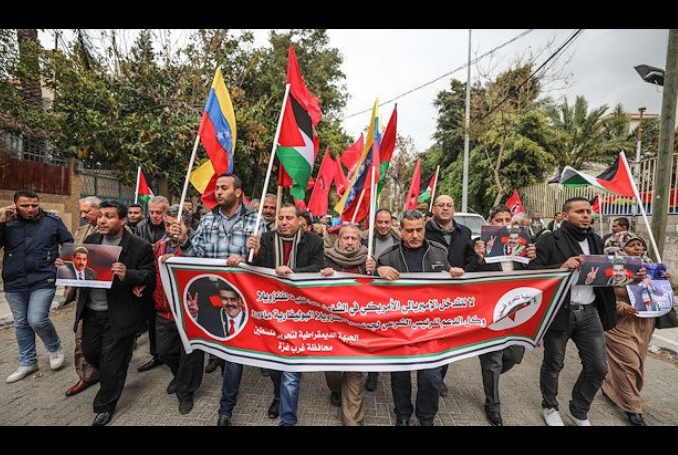
For a people facing systematic genocide, supporting targeted South American nations is a strategic necessity, forging a unified global front against the shared mechanisms of imperial erasure and economic warfare.
The current geopolitical climate is defined by an intensifying use of “maximum pressure” by the US administration. This strategy, combining crippling economic sanctions, diplomatic isolation, and the labeling of resistance movements as “terrorists” has been applied with precision to both Palestine and its most vocal allies.
War on Global South
In late 2025, the US naval presence in the Caribbean and the “State Sponsor of Terror” designations for Cuba and Venezuela are seen by analysts not as isolated foreign policy decisions, but as a coordinated effort to dismantle the autonomy of the Global South.
For Palestinians, these nations are fellow travelers on a roadmap of enforced scarcity and systematic erasure.
Palestinian support for these nations is a rational response to decades of unwavering, principled commitment. Cuba remains the bedrock of this alliance; as the first nation in the hemisphere to recognize the Palestine Liberation Organization (PLO) and the provider of medical education to thousands of Palestinians, Havana offers a model of internationalism that resists even under a sixty-year blockade.
In Venezuela, the Bolivarian movement has consistently used its oil wealth and diplomatic platform to amplify the Palestinian cause. By rejecting the Abraham Accords and maintaining that “the Palestinian cause is the cause of all humanity,” Caracas has positioned itself as an essential buffer against the total diplomatic liquidation of Palestinian rights.
Supporting Venezuela is, for Palestinians, a defense of the very diplomatic infrastructure that prevents their cause from being silenced in international forums.
Palestine as a Rally Cry
The Palestine-Global South alliance has expanded significantly with the emergence of South Africa and Colombia as legal and moral leaders. South Africa’s historic filing at the International Court of Justice (ICJ), supported by Colombia, Bolivia, and Chile, has redefined the conflict as a legal struggle against genocide.
Colombia’s transition under Gustavo Petro from a military client of Israel to a leading voice for a global arms embargo highlights the crumbling of traditional colonial alliances.
Palestinians recognize that Colombia’s internal struggle — to move past a history of state violence and paramilitary repression — is inextricably linked to the Palestinian struggle against occupation. When Petro declares that Si “muere Palestina, muere la humanidad” – if Palestine dies, humanity dies – he is articulating a shared destiny that transcends geography.
The true durability of this bond lies in “people-to-people” solidarity, often operating ahead of official state policy.
In Brazil, while the government maintains pragmatic trade, the Movimento dos Trabalhadores Rurais Sem Terra (MST) and various trade unions have launched massive boycotts against Israeli agribusiness, linking the dispossession of Brazilian peasants to the theft of Palestinian land.
This union-led resistance is mirrored in Colombia and South Africa, where port workers and labor federations have refused to handle Israeli cargo. These acts of “labor internationalism” transform solidarity from a sentiment into a material force.
For the Palestinian worker, the sight of a South African dockworker or a Colombian coal miner risking their livelihood to halt the machinery of genocide is the ultimate validation of their struggle.
New World Order
The alliance between Palestine and these targeted nations is an analytical necessity. It recognizes that the mechanisms used to occupy Gaza are the same as those used to destabilize Latin American democracies: the weaponization of the dollar, the monopolization of military technology, and the criminalization of dissent.
By standing with Cuba, Venezuela, Colombia, and other countries, Palestinians are not just reciprocating support; they are participating in a global project to build an alternative world order. This is a front where sovereignty is indivisible, a conviction that the liberation of the Palestinian people is the final, necessary chapter in the decolonization of the entire Global South.
(The Palestine Chronicle)
No comments:
Post a Comment