
By Ranjan Solomon
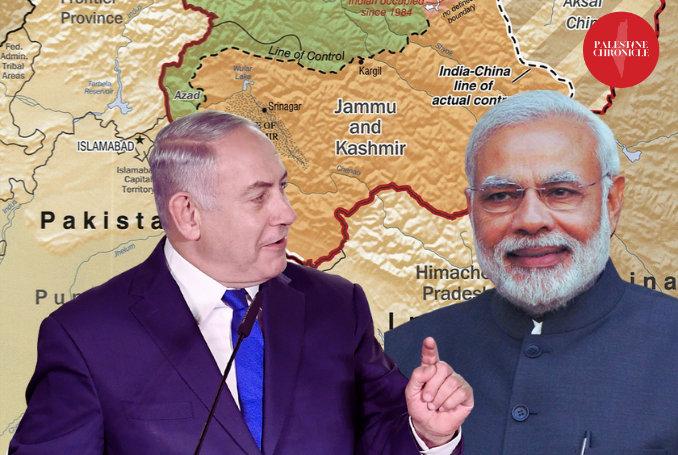
Under the banners of “Make in India” and defense indigenization, New Delhi aggressively expanded domestic arms manufacturing—often through joint ventures with Israeli firms themselves.
As Israel’s war on Gaza triggered unprecedented international outrage, a quieter but no less consequential shift took place in the global arms economy. European states that had long supplied Israel with weapons, components, and logistical support began facing legal challenges, parliamentary pressure, labor resistance, and reputational costs.
Exports slowed, licenses were reviewed, and in some cases, shipments were suspended altogether. Into this narrowing space stepped India—methodically, discreetly, and without moral hesitation. In doing so, New Delhi emerged as a substitute supplier at precisely the moment Israel needed dependable partners most.
This transformation was neither sudden nor accidental. It was the outcome of Europe’s legal constraints colliding with India’s strategic ambitions, ideological alignment, and the deliberate construction of a defence manufacturing ecosystem designed to operate beyond human rights scrutiny.
Europe’s Legal and Political Retreat
By late 2023, the scale of civilian deaths and infrastructural devastation in Gaza made continued arms exports politically and legally toxic for European governments. Courts in the Netherlands ordered a halt to the transfer of F-35 fighter jet components to Israel, citing the risk of violations of international humanitarian law.
Spain suspended arms shipments. In Belgium and Italy, dockworkers refused to load military cargo bound for Israel. Ireland and other EU states saw growing parliamentary dissent, while Germany—Israel’s strongest European ally—faced legal petitions and rising domestic opposition.
Europe’s dilemma was structural. EU export control rules explicitly prohibit arms transfers where there is a clear risk that weapons may be used to commit war crimes or crimes against humanity. Gaza made that risk impossible to deny. Even governments politically inclined to support Israel found themselves constrained by courts, unions, civil society, and legal frameworks that—however imperfectly – still functioned.
Israel, accustomed to uninterrupted European supply chains, suddenly faced uncertainty.
India’s Strategic Opening
India faced no such constraints. Unlike the European Union, India has no human-rights-based arms export regime with enforceable red lines. Parliamentary oversight over defense exports is minimal.
Judicial intervention is rare and easily deflected as a matter of “foreign policy.” Media scrutiny is limited, fragmented, and often drowned out by nationalist messaging. Export licenses can be issued quietly, shipments approved without disclosure, and questions stonewalled under claims of national security.
Crucially, India had spent the previous decade preparing for precisely this moment.
Under the banners of “Make in India” and defense indigenization, New Delhi aggressively expanded domestic arms manufacturing—often through joint ventures with Israeli firms themselves. Israeli designs, Indian production facilities, lower labor costs, and political insulation from European legal regimes created an ideal workaround. What Europe could no longer supply openly, India could manufacture, assemble, or replenish discreetly.
From Buyer to Backup Supplier
For decades, the India–Israel defense relationship was largely one-directional: Israel sold weapons, India bought them. That relationship has now become circular.
India continues to import high-end Israeli systems—surveillance platforms, drones, missile technology—while exporting military materials back to Israel.
These include explosives, propellants, ammunition-related components, drone subassemblies, and logistical inputs essential to sustaining prolonged military campaigns. Such supplies attract far less public attention than fighter jets or missiles, yet they are precisely what wars consume most rapidly.
In other words, as European pipelines slowed under scrutiny, Indian pipelines stayed open.
This quiet substitution mattered. Modern warfare depends less on spectacular weapons systems than on constant replenishment. Ammunition, explosives, and components are the bloodstream of war. By supplying these, India helped stabilize Israel’s military capacity at a moment when international pressure might otherwise have forced meaningful constraints.
Why Israel Trusts India
Israel’s confidence in India as a replacement supplier rests on three interlocking factors.
First, ideological convergence. Both governments frame security through civilizational and majoritarian narratives, depict critics as anti-national or hostile, and dismiss international human rights mechanisms as politically motivated. Militarism is not merely a policy choice but an organizing principle of governance.
Second, reliability. India has shown no willingness to condition defense cooperation on humanitarian outcomes. Where Europe hesitates, India delivers. There are no public red lines, no ethical caveats, and no signals that civilian casualties might alter policy.
Third, discretion. Indian arms exports attract limited global attention and even less domestic debate.
They are shielded by bureaucratic opacity and a political climate that equates criticism with disloyalty. For Israel, facing growing international isolation, this discretion is invaluable.
Labor Resistance: A Telling Contrast
The contrast between Europe and India is perhaps most visible in the realm of labor resistance.
Across Europe, dockworkers, transport unions, and logistics workers have refused to handle weapons destined for Israel, citing moral responsibility and international law. These actions materially disrupted supply chains and amplified public scrutiny.
In India, such resistance has been rare and isolated. Where it has occurred, it has lacked institutional backing and sustained media coverage. India’s weakened labor unions, shrinking space for dissent, and increasingly coercive state apparatus make such disruptions far easier to suppress.
Europe’s democratic friction became Israel’s logistical problem. India’s democratic hollowing became Israel’s solution.
A Shift in the Global Arms Economy
India’s emergence as a fallback supplier signals a deeper transformation in the global arms trade. As rights-based democracies face internal resistance to militarism, supply chains are migrating toward states willing to decouple arms exports from ethical considerations. War, in this model, becomes just another market opportunity.
For India, the costs extend beyond economics. Once celebrated across the Global South as a postcolonial moral voice, India now risks being seen as a transactional power—ready to profit from wars others hesitate to support openly. Strategic alignment with Israel and the broader US-led security architecture may yield short-term gains, but it erodes India’s credibility among nations for whom Palestine remains a symbol of anti-colonial struggle.
Replacing Europe’s Constraints
India did not merely replace Europe as a supplier. It replaced Europe’s constraints.
Where Europe hesitated under law, India advanced under discretion. Where Europe faced protest, India relied on silence. Where Europe risked accountability, India offered compliance.
This role was never announced. It was never debated in Parliament. It required no public justification. It was simply performed.
In doing so, India helped absorb international outrage, reroute pressure, and normalize continuity in Israel’s war economy. The lesson is a bleak one: ethical withdrawal by some states does not end wars—it merely shifts profits and responsibility to others willing to look away.
History will record not only who bombed Gaza, but who ensured the supply lines never ran dry. India’s quiet replacement of Europe ensures it will be part of that record.

– Ranjan Solomon has been a long-time advocate for justice and an independent state for Palestine. He contributed this article to the Palestine Chronicle.
No comments:
Post a Comment