
By Robert Inlakesh
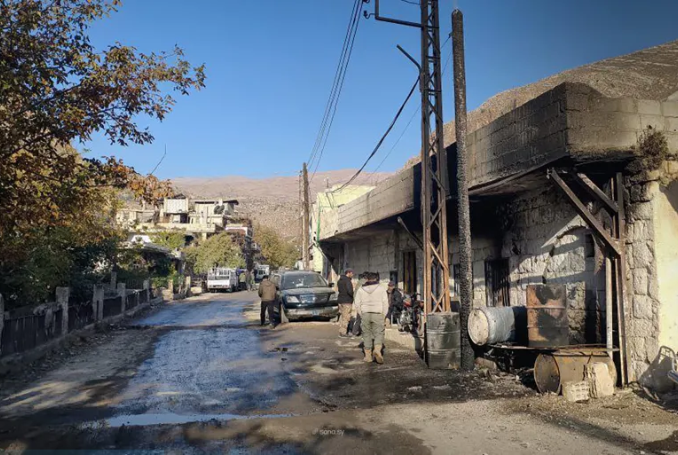
Syrians in Beit Jinn confronted Israeli forces without support from Damascus, signalling a potential new phase of grassroots armed resistance.
During the early hours of Friday morning, an Israeli military unit invaded the village of Beit Jinn, located in the Damascus countryside. Similar raids have become routine in southern Syria, yet this time the locals decided to fight back and, as a result, were subjected to hours of airstrikes.
At around 3 AM local time, what the Hebrew media claimed was an Israeli reservist unit had run an incursion into the Damascus countryside, specifically targeting the village of Beit Jinn. Initially, the Israeli media had reported that a “sweeping” operation had taken place, during which the occupation soldiers were subjected to a sudden, violent ambush.
Initially, the Israeli army radio reported 6 soldiers were injured, 3 were said to have been in serious to critical condition. Syrian local media claimed these three soldiers were killed. Later, Israeli Hebrew media reports indicated 13 injuries had been sustained.
What ensued was a two-hour-long rescue operation, involving drones and helicopters. Some also claimed fighter jets were mobilized. The village of Beit Jinn was repeatedly bombarded from the air and with tank fire, ultimately killing at least 20 Syrian villagers, including women and children. Dozens more were also injured.
A number of competing narratives have since emerged, claiming to characterise the situation that unfolded. The Israeli media began claiming that the military was conducting an arrest operation when they were suddenly ambushed, contradicting previous claims about a sweeping operation.
In the end, the Israeli army announced it had kidnapped a number of Syrian militants that it was pursuing and hence successfully completed its “mission”. There were Israeli claims that these alleged militants were suspected of previously firing rockets and planning past attacks on Israeli forces near Dara’a, but they provided no evidence or the names of those they kidnapped.
What we do know is that a Syrian fighter named Hassan Mohammed Abdul Razzaq al-Saadi was killed in an armed clash with the Israeli military. We also know that the ambush on the occupying force was carried out in close quarters and that an Israeli armoured Humvee was destroyed. It also confirmed that a rescue operation was carried out and that soldiers were transported to different hospitals through airlifts, including to a medical facility in Haifa. It is also apparent that the Syrian force that carried out the ambush was armed with light weapons.
Israel claims that it bombed its own military vehicle after it had already been rendered inoperable. However, there is no crater typically inflicted by such an airstrike, meaning that it is possible it could have been destroyed by the Syrian forces alone.
Another narrative produced by the Israeli media was that due to the clash having been carried out at such a close range, the air force couldn’t immediately intervene. This is also a questionable claim, as reports initially indicated a fear of soldiers being taken captive, likely indicating a loss of communications, and under such circumstances, the infamous Hannibal Directive is routinely triggered.
Regardless of the specific details of the clash, which the Israelis are infamous for concealing, Beit Jinn was besieged after it took place, and emergency services were blocked from entering the village in order to tend to the dozens of civilians wounded. The minaret of a local mosque was struck and a building was bombed, burying civilians beneath it.
Where Does This Lead?
The armed clash, which has been characterised as the most intense since the fall of former Syrian President Bashar al-Assad, occurred on the same day that Syria’s new leader, Ahmed al-Shara’a, had previously called for mass demonstrations.
Friday’s pre-planned demonstrations were called for after mass protests across Homs and the Syrian coastal region by the Alawite minority sect inside the country, following various cases of sectarian violence against their communities. Sheikh Ghazal Ghazal, who leads the Supreme Alawite Islamic Council, had urged his people to protest for both equality, also communicate the message of federalism.
Ahmed al-Shara’a responded in a televised speech, after sectarian counter-protests had also taken place, some calling for the extermination of Syria’s Alawites, asserting that the country should do away with sectarianism and reject dividing the country. However, despite his statements about unity, many feared that his call for unity protests, designed to celebrate the current administration, was going to trigger even more sectarian demonstrations.
What ended up occurring was that many of the demonstrations, the largest of which was the well-organized event in Damascus, turned into anti-Israel protests instead. Sectarian chants were still present in Damascus and elsewhere, yet the opposition to Israel’s attack on Beit Jinn and celebrations of its resistance steered the street mobilizations, as many called for retaliation and burned Israeli flags.
So far, the new Syrian leadership has refused to fire a single bullet towards Israeli forces and has attempted, but failed, to disarm many southern Syrian communities. Meanwhile, Ahmed al-Shara’a has welcomed Zionist delegations to Damascus and opened direct communication, as well as participated in negotiations, with the leadership in Tel Aviv. Despite pleas for help from the people of Beit Jinn, no Syrian forces were mobilized to aid them, leaving the village defenseless.
Initially, the Israelis accused the Islamic Group of being behind the ambush against its occupying forces. Al-Jama’a Al-Islamiya, or the Islamic Group, is a Lebanese resistance organisation rooted in the Muslim Brotherhood; its armed wing is called the Fajr Forces. It is also known for its close relationship with Hezbollah, Hamas, Palestinian Islamic Jihad (PIJ), and other Palestinian factions. It later denied any involvement.
Blaming the Islamic Group enabled the Israelis to point their finger at Iran and Hezbollah, yet there has been no proof presented to support this notion. Additionally, later reports produced in the Hebrew media had indicated that the ambush was spontaneous and not pre-planned, although this is currently unconfirmed.
Some Syrian telegram channels later began claiming that an ISIS cell had claimed responsibility, yet there were no official statements in this regard, and it is more likely that ISIS supporters were spreading rumours to bolster their image.
Finally, Al-Moqowameh Al-Wataniyeh Fe Souryia, which translates to the Syrian National Resistance in English, released a video message claiming their responsibility for the ambush operation. It is currently unclear who runs this group, yet its logo does appear to be a similar design to Iranian Islamic Revolutionary Guard Corps (IRGC) aligned movements. It is possible that this group was responsible and had a cell waiting in the village of Beit Jinn, as the Syrian National Resistance has claimed smaller attacks in the past.
As details evidently remain scarce, it is important to consider the direct repercussions of this major event. As a result, the Israeli military is acting in a much more aggressive manner in southern Syria, where it has already occupied over 400 square kilometers of territory. This is a portion of land larger than the Gaza Strip.
Negotiations between the Hayat Tahrir al-Sham (HTS) leadership and Israel on reaching a “security agreement” recently faltered, reportedly due to Israeli demands that entailed handing over southern Syrian lands to it. Therefore, the Israelis were already adopting a more aggressive approach towards Damascus and this incident only encourages that trend further.
The Israelis have so far taken everything they have sought inside Syria, without any demands or pushback from the leadership of Ahmed al-Shara’a. Damascus even handed over the belongings of infamous Israeli spy Eli Cohen, along with the bodies of Israeli soldiers captured in 1982, without anything in return.
Meanwhile, the Israelis have destroyed the former Syrian Arab Army’s strategic arsenal, seized key water assets in southern Syria, established dominance over the high point of Jabal al-Sheik (Mount Hermon), begun backing Druze separatist militias, murdered hundreds of Syrians, struck the ministry of defense, and even bombed next to the Presidential Palace.
As this has been happening and the occupying forces seize more Syrian lands, Ahmed al-Shara’a has been busy cosying up to the Trump administration, playing basketball with the leaders of US Central Command, not daring to impose any red lines on the Israelis, nor threaten retaliation.
The lack of any threat from the rulers in Damascus is, however, irrelevant to Tel Aviv’s calculations. If Ahmed al-Shara’a were to order any action against them, or even enable Syrian militias to mobilize to confront the occupying forces as they advance, the Israelis would likely eliminate the Syrian leader with an airstrike.
So far, such an option has been avoided by the Israelis, not only due to the closeness between Damascus and Washington, but also because they aren’t currently facing any major threat from Syrian armed groups in the south of the country. A move like this would probably trigger militant groups to attack them, which would require a significant Israeli ground force to combat.
It is therefore more likely that if Israeli Prime Minister Benjamin Netanyahu decides that the Syrian leadership has passed its usefulness to them and is beginning to pose problems, they could, in fact, carry out an assassination operation on the ground.
The aim of such an assassination attack, opposed to an airstrike, would be to trigger a power struggle between competing Syrian armed factions, which would weaken and distract them from an even greater Israeli incursion into Syria. Simultaneously, its allied militia forces in Sweida could be called upon to undertake specific military actions.
One potential problem lies in the way of Israel escalating to this extent, the influence of Turkiye in the country, which has already rooted itself in the Syrian city of Aleppo since the fall of Bashar al-Assad. It is unclear just how far Ankara will go to maintain its strategic foothold in Syria. If it seeks to combat the Israeli agenda, it may eventually choose to use proxy forces in order to do this, although such a move would trigger a major crisis and therefore is of lower likelihood.
The Israeli media have recently been claiming that PIJ is building its strength and rapidly arming its fighters inside Syria, allegations that PIJ denies as incitement against Palestinian refugees. It is reasonable to assume that PIJ, which has long been rooted in Syria, does still possess capabilities there, although these claims from the Israelis appear to be geared towards pressuring the Syrian government to undergo a major crackdown against Palestinian groups.
Factually, the current leadership in Damascus is extremely weak. It does not possess a real army, instead drawing its power from militia groups, many of which are sectarian extremist groups only mobilized for the purpose of fighting other Syrian armed groups. If the current administration were to wage war on Israel, it would suffer enormous losses, and Ahmed al-Shara’a would become an immediate target for assassination. But such a development is highly unlikely, as it appears there is no desire to follow this path. If it occurs, it will be because Damascus has lost control of the situation.
Saying this, there really is no other option except resistance for the Syrian people if they hope to unite and rescue their country. This will mean enormous sacrifice, but it is the only way to deter the Israelis from continuing to seize more land and break the country into sectarian mini-states.
The future of Syrian resistance could go in any direction from here. Suddenly, there could be a mobilization of forces to combat Israel, but it is more probable that the Israelis will use their air dominance over the country to impose their will, while refraining from escalating the conflict on the ground. If the Israelis choose to continue escalating on the ground, it indicates that they see the collapse of the HTS administration as imminent.
(The Palestine Chronicle)
– Robert Inlakesh is a journalist, writer, and documentary filmmaker. He focuses on the Middle East, specializing in Palestine. He contributed this article to The Palestine Chronicle.
No comments:
Post a Comment