
By Benay Blend
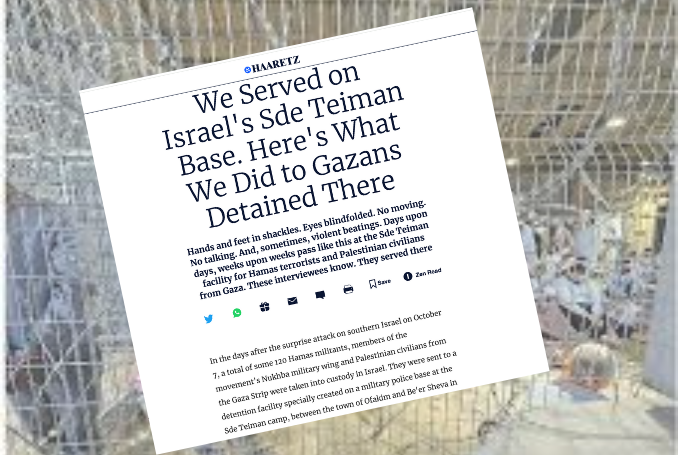 An unnamed Israeli physician gave a first-hand account to the Israeli newspaper Haaretz on Friday of the inhumane practices detainees from Gaza are subjected to. (photo: screen grab)
Western press has ignored the Sde Teiman scandal and, with Jeffrey Epstein, media has made little mention of the victims. In both cases, Israeli soldiers and the Epstein crimes, the criminals will not be held accountable for their crimes.
Palestinians from Gaza, recently released from Sde Teiman torture camp, have given harrowing testimony that details widespread sexual abuse by their Israeli captors. The victims of these crimes have been largely ignored by Western media, which focused, instead, on Israeli Military Advocate General, Major-General Yifat Tomer-Yerushalmi, who leaked the story.
In the case of the recently released files of the late sexual offender, Jeffrey Epstein, media attention has centered on how this information will adversely affect President Trump, but little mention, if any, has been made of how these crimes will impact the victims.
As for the Sde Teiman incident caught on camera, Israelis are angrier about the damage to their country’s reputation than they are about the details of the rape itself. Indeed, Israeli Defense Minister Israel Katz has called the video’s release a “blood libel” against the Israeli state, referring here to the false accusation that Jewish people use the blood of Christian children for certain religious rituals.
Ironically, Israel used false accusations of mass rape by Hamas fighters on October 7 to justify the ensuing genocide. Not only was this reported widely in the press, but former President Biden repeated these lies, along with claims that he had seen photos of Israeli children beheaded by Hamas fighters, an assertion that was clearly false.
Biden and his administration might have professed empathy for Palestinians, but his words belie that claim.
“People who deny others justice and equality are not interested in peace,” writes Jacquie L’uqman, activist, journalist, radio host, and Coordinating Committee Chair of Black Alliance for Peace. “Their very beliefs put into action against others is violence.”
“This atrocity propaganda is designed to justify genocide,” tweeted journalist Ali Abunimeh, thus reiterating L’uqman’s notion that certain words translated into action result in violence. “We don’t know what Israel showed Biden, and Biden is a known liar, as is the United States, which killed a million people based on lies about ‘weapons of mass destruction.’”
Israel has long used rape as a means to control Palestinian resistance. On October 11, 2015, Israel arrested poet Dareen Tatour on the charge of “incitement through social media.” Cited for three Facebook posts, including the poem “Resist, My People, Resist Them,” she spent three months in Israeli prison before being released under house arrest.
“On a personal and political level,” Tatour explained in an interview with Kim Jensen, “the two (the state and patriarchal society) are linked” by the misogynist act of rape. Tatour continued that “rape is like occupation and vice versa,” two assaults against which she remains defiant. Because she is a woman who “loudly declared the identity of both (her) rapists,” the Occupation and the other assailant who raped her body, the State tried to “imprison (her) voice” by detention. Though her rapist enabled the authorities to arrest her, both failed to keep her quiet.
In a United Nations Report dated March 13, 2025, findings of the Human Rights Council (HRC) corroborate Israel’s use of sexual, reproductive and other gender-based violence that has escalated since October 7, 2023.
The Report also documented the same abuses perpetrated against Palestinian men and boys. Forced public stripping and nudity, as well as sexualized torture and ill-treatment – all are meant as collective punishment designed to “punish, humiliate and intimidate Palestinian men and boys into subjugation.”
Entitled “More Than a Human Can Bear,” the findings show a clear pattern of sexual abuse designed to “subordinate, destroy and expel the Palestinian community” from their land.
The case of the late Jeffrey Epstein files follows this same familiar path. While speculation about the recent Congressional vote to release the files made the nightly news, not as much attention was placed on the victims of these crimes, children who were sexually abused and trafficked at Epstein’s various homes.
In an opinion piece for the New York Times, novelist Jennifer Weiner writes that “we’ve heard endless details about the predators and the men in their social circle, we have heard far too little about – and from – the victims.”
Instead, while liberals have focused on the ways that the files might be damaging enough to bring down the President and his cohorts, Trump loyalists hope to expose powerful Democrats on the other side of the aisle.
“Perhaps the Epstein files will give liberals a tool with which to pry MAGA faithful away from the president. Perhaps they’ll give the president an excuse to prosecute political opponents,” Weiner pens. “Either way, treating Mr. Epstein’s crimes as a political opportunity insults the countless women and girls he abused.”
“It’s more fun to snicker over a story about Mr. Trump leering at young women in a swimming pool, walking into a glass door and leaving his nose print behind,” Weiner writes, “than to hear, for example, Michelle Licata on Netflix’s documentary series ‘Jeffrey Epstein: Filthy Rich’ recounting Mr. Epstein’s abuse. ‘I felt so used,’ she says. ‘Like it was … I was just like this dirty person.’”
As Romana Rubeo notes, the Sde Teiman scandal, too, has received very little attention in the Western press. As the Managing Editor of Palestine Chronicle, she has had access to troves of testimony from detainees, medical reports, video evidence, and judicial proceedings, information that mainstream news, along with Western feminists, ignored.
This lack of interest, Rubeo concludes, is “not merely linguistic. It is structural, reflecting the human worth built into Western coverage of the war.”
In both cases, Israeli soldiers and the Epstein crimes, there will likely be no consequences for the criminals who wreaked violence upon men, women, and children.
Writing for The Guardian, Rebecca Solnit explains why this might be so. Rather than treating each high-profile case individually, she suggests that investigators would be better served by searching for systemic patterns that occur across all levels of society.
For feminists, Solnit claims, the cause is rooted in misogyny, violence that is intended to perpetuate “inequality, exploitation and subordination.” Focusing on high-profile cases, she includes, avoids this explanation because there is no visible pattern to link the cases together.
Solnit is correct in her assessment. There is a need to view violence against women on a more transnational scale yet, when mainstream feminists do so, they invariably stop short of including Palestinian women.
Moreover, the plight of Palestinian women in Israel’s jails is far more complex than just one cause – misogyny. In these cases, nationalism, racism, colonialism, and the dehumanization of both men and women offer a more satisfying explanation for abuse.
In “Greater Than the Sum of Our Parts: Feminism, Inter/Nationalism, and Palestine,” Palestinian (2023), feminist scholar Nada Elia critiques various forms of feminism that do not center the interconnected struggles against colonialism, patriarchy, racism, and imperialism. Her work focuses on solidarity across global struggles against oppression.
“Thankfully, today,” Elia writes, “progressive women of color and Indigenous women, along with anti-imperialist, anti-racist white women, are firmly anti-Zionist, understanding that no ideology that hinges on supremacy and discrimination is reconcilable with feminism” (p. 73).
“Feminism” that “aligns with regimes that engage in racist and ethnic oppression” is labeled “gendered supremacy” (p. 73) according to Elia’s framing.
Like the abuse that Solnit mentions, testimonies collected by the Palestinian Centre for Human Rights (PCHR), in particular, accounts of sexual torture, including rape, forced stripping, forced filming, sexual assault using objects and dogs, and psychological humiliation, involved a systemic policy rather than individual incidents, all within the context of ongoing genocide and forced displacement.
Nevertheless, as Nada Elia writes: “New life is germinating in the crevices of hope” (x). Just as structural oppression stems across the globe from the same components – “capitalism, neoliberalism, ‘development,’ and militarized right-wing authoritarianism” (p. x), so resistance draws from connected movements for freedom – “a global intifada from Turtle Island to Palestine” (p. x), spearheaded by Palestinian sumud (steadfastness) and struggle.
– Benay Blend earned her doctorate in American Studies from the University of New Mexico. Her scholarly works include Douglas Vakoch and Sam Mickey, Eds. (2017), “’Neither Homeland Nor Exile are Words’: ‘Situated Knowledge’ in the Works of Palestinian and Native American Writers”. She contributed this article to The Palestine Chronicle.
No comments:
Post a Comment