
By Ramzy Baroud

If Hezbollah fails to treat the assassination of Haitham Ali Tabtabai as a non-negotiable red line demanding a decisive response, Israel will undoubtedly be crowned the victor in Lebanon.
If Hezbollah fails to deliver a decisive response to the Israeli assassination of its senior military commander, Haitham Ali Tabtabai (Sayyed Abu Ali), on November 23, 2025, Israel will seize upon an irreversible conclusion: the gates of maximal escalation are now wide open. Furthermore, Israel will operate under the belief that not even the elimination of the Lebanese resistance group’s Secretary-General could fundamentally alter the strategic balance.
But how was this dangerous precipice reached? And what agonizing options confront Hezbollah?
Inevitable Post-Truce One-Sided War
Immediately following the ceasefire agreement reached between Israel and Lebanon on November 27, 2024, which concluded a devastating three-month war between Israel and Hezbollah, Israel exhibited an immediate intent to escalate.
The subsequent Israeli expansion, which commenced with the occupation of five locations, was directly tethered to the nature of the agreement. This accord extorted a major concession from the Lebanese resistance: the mandatory withdrawal of all forces north of the Litani River, a relentless and historical Israeli objective.
Israel’s Colonial Obsession with the Litani
Indeed, since its very inception, Israel has fixated on controlling South Lebanon, with the Litani River serving as the ultimate territorial marker.
It has repeatedly launched wars and maintained brutal, prolonged occupations specifically to attain this boundary. The hollow Israeli justification that this maneuver is a security necessity is unequivocally false. Instead, the true aim is twofold: linked directly to Israel’s drive for colonial and territorial expansion, and its desperate, strategic interest in usurping more sources of water.
While the Lebanese resistance has perpetually striven to liberate every square inch of Lebanon from Israeli subjugation, the Litani River, owing to Israel’s objectives, has also become a critical strategic fault line for the resistance. Therefore, Hezbollah’s retreat north of the Litani represented a seismic concession, wrung out by multiple, converging pressure fronts.
Converging Forces of Erosion
The first pressure front was the sheer brutality of the war, which resulted in the slaughter of over 4,000 people and the grievous wounding of over 17,000 people.
Second, Israel’s successful, targeted campaign to decapitate Hezbollah’s leadership, culminating in the assassination of iconic Secretary-General Sayyed Hassan Nasrallah on September 27, 2024. The killing of Haitham Ali Tabtabai—a central figure who had just assumed supreme military command is the latest stage of this systematic purge of the military hierarchy.
Third, and perhaps most corrosive, is the ingrained Lebanese disunity and the overt US, and even Israeli, manipulation of the resistance’s traditional domestic enemies. These factions eagerly sought a weakened Hezbollah, viewing its vulnerability as their golden opportunity to savage a traditional adversary that has fundamentally altered the nation’s political and demographic power structure.
The Damascus Factor
Syria, too, weighs heavily on Hezbollah’s strategic calculus in overlooking the Israeli ceasefire violations, which now number in the thousands. The collapse of the former Syrian government, a long-standing ally of Hezbollah and the indispensable land bridge between Iran and Lebanon, was a crushing strategic blow.
Compounding this disaster, the new Syrian regime now aligns closely with Hezbollah’s historical opponents, namely the Gulf region. This regime, since its ascendancy in December 2024, has secured the full endorsement of the Trump Administration.
Despite Syria itself being brazenly violated by Israel numerous times since the rise of Mohammed Shari’s government, Damascus has offered no meaningful retaliation to the Israeli incursions and the expanding occupation of Syria’s southern border areas and the Golan Heights.
A Nationally and Strategically Exposed Position
While Hezbollah is believed to have fully rebuilt its core military capabilities after the war, it remains in a profoundly weakened position, both nationally and strategically. The latter vulnerability is a direct consequence of the shifting political dynamics in the Middle East, where the Arab regimes continue to slavishly execute Washington’s designs, even at the fatal expense of their own national interests and the region’s future.
On the national stage, countless forces in Lebanon continue to prioritize their narrow sectarian political interests over the nation’s survival. Instead of forging a united front against Israel’s continuous war on the country—which has inflicted ceaseless deaths, injuries, and the deliberate targeting of homes and infrastructure—they are instead united in their opposition to Hezbollah.
The Fatal Demand for Disarmament
On September 5, 2025, the Lebanese government, acting under intense pressure from Washington and its envoy to Lebanon, Tom Barrack, passed a decision to implement UN Resolution 1701 to disarm Hezbollah and fully deploy the Lebanese Army in the South. The grim, bewildering mockery here is that the mere attempt to forcibly disarm Hezbollah will almost certainly trigger a devastating civil war.
Regardless of the ensuing carnage, Israel would then be able to permanently and uncontestedly seize parts of Lebanon, advancing relentlessly up to the Litani River. This is the tragic state of affairs in Lebanon, where national survival is deemed marginal in the face of sectarian rivalries, allowing foreign powers, starting with the US, to dictate the nation’s political, economic, and security agendas.
The Ultimate Test of Will
Israel assassinated Haitham Ali Tabtabai, a commander vital to the resistance’s field operations, as the ultimate test of will for Hezbollah and Lebanon. If Hezbollah retaliates, Israel and its American patrons will exploit the resulting conflict to fatally weaken the group against its traditional Lebanese enemies.
But not retaliating is an infinitely greater catastrophe, as it will send an unmistakable signal to Israel that the time is fully ripe for a major military conquest, which will inevitably result in the occupation of more Lebanese territories, progressing inexorably toward the Litani River.
In a blistering address delivered last March, Hezbollah Secretary-General Sheikh Naim Qassem issued a definitive ultimatum, declaring that: “The chance given to the government to defend Lebanon is not endless, and we are not weak in the face of the US-Israeli schemes.”
He then dramatically escalated the warning: “If we reach a point where the Israeli actions are nothing except killing, destruction, and occupation, we cannot remain spectators. Don’t underestimate our words. If ‘Israel’ does not comply, we will have no choice but to resort to other options.”
This position has been reiterated relentlessly since that speech, yet the Lebanese government has proven incapable of defending the nation, and Israel has only intensified its campaign of killing and property destruction. If the resistance group fails to treat the assassination of Haitham Ali Tabtabai as a non-negotiable red line demanding a decisive response, Israel will undoubtedly be crowned the victor in Lebanon and will operate with permanent, total impunity. The very future of Lebanon—its territorial integrity and political sovereignty—is now hanging by a thread.
(The Palestine Chronicle)
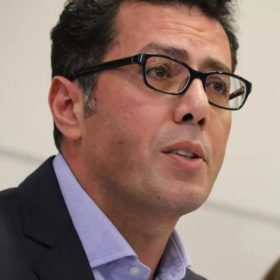
– Dr. Ramzy Baroud is a journalist, author and the Editor of The Palestine Chronicle. He is the author of six books. His forthcoming book, ‘Before the Flood,’ will be published by Seven Stories Press. His other books include ‘Our Vision for Liberation’, ‘My Father was a Freedom Fighter’ and ‘The Last Earth’. Baroud is a Non-resident Senior Research Fellow at the Center for Islam and Global Affairs (CIGA).
No comments:
Post a Comment