
By Dan Steinbock
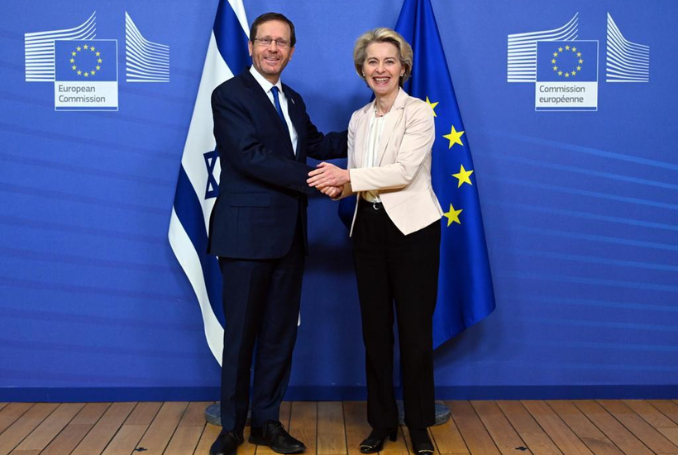 EC President Ursula Von Der Layen with Israeli President Isaac Herzog. (Photo: Haim Zach / Government Press Office of Israel, via Wikimedia Commons)
Recently, the EU/EC position has toughened on Israel’s genocide in Gaza. But why did the stance change only after the deaths and injuries of a quarter of a million Palestinians and both EC President von der Leyen and EU foreign policy chief Kallas have been charged for genocide?
Recently, EU foreign policy chief Kaja Kallas said that US support for “everything that the Israeli government is doing” limits the EU’s leverage to change the situation on the ground in the Gaza Strip.
Subsequently, European Commission President Ursula von der Leyen proposed sanctions against Israeli ministers and a partial suspension of the Israel trade deal. On Wednesday, the EU Commission’s review discovered – after 21 months of mass atrocities in Gaza and violent pogroms in the West Bank – that actions taken by the Israeli government in the Palestinian-occupied territories represent a ‘breach of essential elements relating to respect for human rights and democratic principles,’ which permits the EU to suspend the agreement unilaterally.
Recently, these sentiments were reinforced with the recognition of the state of Palestine by US allies – the UK, Canada and Australia – and more recently by France.
Observers of Brussels declared that the EU had become tough on genocide. In reality, it was a last-minute effort by the two EU leaders to fuse rising outrage against EU’s Gaza policies and charges that they were complicit in Israel’s atrocities.
How Kallas Emboldened Israel in Gaza
Addressing the annual EU Institute for Security Studies (EUISS) conference in Brussels, Kajas said that US backing of Israel undermines EU leverage to stop the “Gaza war.” Yet, the United States has supported Israel for more than half a century.
“We are struggling because 27 member states have different positions,” on the issue, Kallas explained. “Europe can only use full force when it acts together.” In this way, accessorial complicity is first deflected to Washington and then attributed to the absence of European unity, which Kallas has long called for, to confront Russia. In other words, the EU Gaza apology was a thinly-veiled effort for a plea to unity, Kallas hoped to turn against Russia in Ukraine.
When asked about “double-standard” accusations towards the bloc on its Gaza policy, Kallas said it is not true that the EU is inactive on Gaza. Yet, previously, she had opposed intervention in Gaza. In mid-July, Kallas and the foreign ministers of the EU member states chose not to take any action against Israel over alleged war crimes in the Gaza war and settler violence in the West Bank.
The then-proposed sanctions against Israel would have included suspending the EU-Israel Association Agreement, suspending visa-free travel, and blocking imports from Israeli settlements. This decision emboldened the Netanyahu cabinet, which saw the EU’s decision not to impose sanctions on Israel as a diplomatic victory. It also led UN Special Rapporteur Francesca Albanese to conclude that EU officials like Kallas were complicit in Israeli war crimes in Gaza.
The EU is Israel’s biggest trading partner, accounting for a third of Israel’s total trade in goods with the world in 2024, whereas Israel is only the EU’s 31st largest trading partner. Consequently, the EU could easily have sanctioned Israeli trade right after the first genocidal atrocities in late 2023, yet it chose not to. Why?
How Von der Leyen Undermined EU’s Credibility
Von der Leyen has a track record of intimate relations with Israel. It was a source of controversy already before the Gaza catastrophe. On the 75th anniversary of Israel’s independence, half a year before October 7, 2023, she referred to Israel as a “vibrant democracy” in the Middle East that made “the desert bloom.” These remarks were criticized as racist by the foreign ministry of the Palestinian Authority because they erased the history of Palestinians in what is today Israel.
After the Hamas offensive, von der Leyen was criticized by EU lawmakers and diplomats for supporting Israel and not calling for a ceasefire. A week after October 7, she rushed to visit Israel to express solidarity, even as the Netanyahu cabinet spoke openly about the coming destruction of Gaza, and the ethnic cleansing of Palestinians. Then-EU foreign policy chief Josep Borrell criticized her for the pro-Israeli stance, which “had a high geopolitical cost for Europe.”
The visit and the rhetoric also sparked furor among 841 EU staff who signed a letter to von der Leyen criticizing her stance on the conflict. In their view, the commission was giving “a free hand to the acceleration and the legitimacy of a war crime in the Gaza Strip” and warned that the EU was “losing all credibility and the position as a fair, equitable and humanist broker.”
In reality, that credibility has eroded for years. By the early 2020s, more than 800 European financial institutions, including Europe’s most luminous financial giants, had financial relationships with over 50 businesses that were actively involved with Israeli settlements.
Why the Belated Moral Outrage
Recently, the European Commission presented a proposal for tougher measures against Israel to the European Union, which featured suspending parts of the EU-Israel trade agreement and sanctioning Israeli far-right ministers and some West Bank settlers, along with Hamas leadership. These measures are very much in line with the EC chief’s previous warning. But why do they come only now, after 21 months of genocidal atrocities, the obliteration of Gaza and a quarter of a million killed or injured Palestinians?
A qualified majority vote among EU governments will still be required to pass the measures, with the support of at least 15 of the 27 EU members representing two-thirds of the EU population.
Moreover, von der Leyen’s Gaza criticism was carefully calculated to limit the scope of possible sanctions. “Man-made famine can never be a weapon of war,” she said. “For the sake of the children, for the sake of humanity – this must stop.”
Yet, Israel’s weaponized famines did not start a few weeks ago. They date from the 2006 Palestinian democratic election, which was won by Hamas in both Gaza and the West Bank. It led to Israel’s blockade, which was supported by the US and the EU, and the Israeli-manufactured famine, designed to starve Gaza. The blockade paved the way to almost two decades of impoverishment, hunger, unemployment and thus to October 7, 2023. But it did not trigger condemnations by von der Leyen or the then-EU leaders.
Worse, the world witnessed the first starving victims in Gaza already in spring 2024. Yet, neither von Der Leyden nor other European leaders demanded an end to Israel’s actions at the time. And by the turn of 2023/24, still another famine way ensued, with similar silence in Brussels. It was only the third wave of famine in mid-2025 that changed their views. But why?
“What is happening in Gaza,” von der Leyden said, “has shaken the conscience of the world… These images are simply catastrophic.” That was the difference: not the realities of weaponized famines, which the world had witnessed for almost two decades in Gaza, but the images.
As those photos of starved bodies, particularly of children and babies, could no longer be halted or sidelined in international media, EU politicians, pushed by their constituencies, were compelled to act.
What European Leaders Chose Not to Do
It was when the European leaders were charged with complicity that von der Leyen and Kallas reacted. What the former proposed was “a package of measures” against Israel over its ongoing genocidal assault on Gaza. Or as she put it – and let’s italicize the key terms – “We will propose sanctions on the extremist ministers and on violent settlers. And we will also propose a partial suspension of the Association Agreement on trade-related matters.”
The EU would not use its full arsenal to change Israel’s conduct. It would only go after a few ministers of the Netanyahu cabinet, but not the cabinet itself, even though most of its members had been complicit in the Gaza catastrophe, with some supporting even harsher measures, including “nuking” Gaza.
Similarly, the EU would only go after a few token settlers, not the illegal settlements that now house up to 750,000 Jewish settlers. Nor would the EU go after hardline Israeli politicians and civil administrators who have been preparing the incorporation of the West Bank into the pre-1967 Israel since their electoral triumph in late 2022.
The ties between Israel and the United States have expanded from hedging and strategic partnership into a virtual symbiosis. Since 1950, Israel has received more than $120 billion in US aid, most of it in military aid; after October 7, this aid has soared up to $23 billion. But Washington is not Israel’s only ally. In the past half a decade, only three countries—the US (66% of Israel’s total arms imports), Germany (33%), and Italy (1%) —have supplied most of Israel’s arms.
Several other European countries have supplied vital military components, ammunition, and services, including the UK, France, and Spain. Meanwhile, small EU members like the tiny Finland are increasingly reliant on Israeli arms imports.
The elevated arms transfers reflect the contested European shift toward rearmament, at the expense of welfare and social services, despite the soaring challenges of aging demographics and climate change.
(Building on The Obliteration Doctrine, the original commentary was published by Antiwar.com on September 23, 2025.)
– The author of The Fall of Israel (2024) and The Obliteration Doctrine (2025), Dr Dan Steinbock is the founder of Difference Group and has served at the India, China and America Institute (US), Shanghai Institute for International Studies (China) and the EU Center (Singapore). For more, see https://www.differencegroup.net/

No comments:
Post a Comment