Palestine and Partition: The Rise and Fall of the ‘Two State Solution’ (Part One)
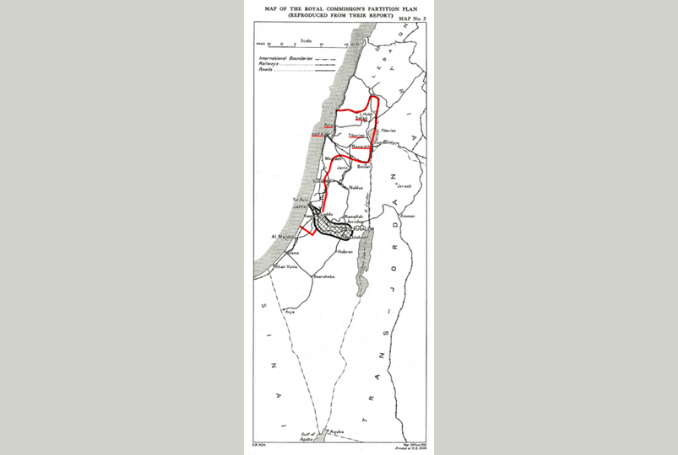
A map of the Peel commission's plan for partition. (Photo: supplied)
The fact that Israel could not exist, were the rights of the 1948 generation to be upheld, sidesteps the moral and legal arguments and in this context underlines the illegitimacy of a ‘Jewish’ state.
In the welter of statements about a ‘two-state solution’ based on the division of the territory occupied by Israel in 1967, there is a critical omission: Palestine is not just about 1967.
The rights of the Palestinians driven out of their homeland in 1948 are just as important as the rights of those who have lived under occupation since 1967. Palestinians have never surrendered any of these rights. Partition always has been a solution the ‘west’ has tried to impose on them.
Even if they had accepted partition, the territories outside those assigned to a Jewish state that were seized by the Zionist militias in 1948/9 are just as illegally held as those occupied since 1967. The fact that Israel could not exist, were the rights of the 1948 generation to be upheld, sidesteps the moral and legal arguments and in this context underlines the illegitimacy of a ‘Jewish’ state.
The Palestinians opposed the ‘two state solution’ vigorously from the time it was first proposed by the Peel Commission in 1937, they opposed it in 1947 and accepted the idea only under duress in the 1980s. Even then, they did not concede any of their basic rights, principally the ‘right of return’ enshrined in UNGA resolution 194 of 1948 and reaffirmed regularly ever since.
Arafat’s recognition of the state Israel in 1993 without the corresponding recognition by Israel of a Palestinian state was disastrous. He threw away his trump card and the subsequent negotiations only gave Israel more time to settle and consolidate its hold on the territories seized in 1967.
As the ‘two state solution’ goes all the way back to the Peel Commission in 1937, it seems timely to see what it had to say, even if Israel has now openly and aggressively ruled out anything but a Jewish supremacist state across all of Palestine.
In the 1930s, with the assumption of the mandate ending in the establishment of one state already proving unworkable, the Royal Commission headed by Lord Peel was assigned the task of coming up with an alternative.
It began by noting that “the Jewish national home is no longer an experiment” given the number of European settlers in Palestine. In the commission’s view, setting out where it intended to go, “there can be no question of fusion or assimilation between Jewish and Arab culture. The national home cannot be half national.”
This was deception, as over centuries there always had been fusion and “assimilation” between Jewish and ‘Arab’ and Islamic culture,’ although integration might be a better word than ‘assimilation.’
In their daily lives, Jews were part of Arab culture. Their religious practices were different but otherwise they were Arab Jews, just as Christians were Arab Christians.
The Jews in Palestine and across the Arab world had long since been “assimilated.” What could not be assimilated by the Palestinian people was the onrush of European Zionist settlers and the clear intention not to create a ’national home’ in Palestine but to turn it into a Jewish state.
The commission was open about what the Zionists wanted, as expressed by the Jewish Agency: “There should be no restriction on immigration nor anything to prevent the Jewish population in time becoming in course of time a majority in Palestine … to that it is replied (by the commission) that such a policy could only be maintained by force.”
In fact, force was already dominant. The Palestinian uprising began the year before was being crushed by the British occupation forces. While the Palestinians were being disarmed, the zionist settlements were arming under British protection.
The commission thought that should violence break out “again” (it was continuous and had been breaking out intermittently since 1921), there should be no hesitation in enforcing martial law. “Disarmament (of the Palestinians) should be enforced” and “the supernumerary police for the defence of the Jewish settlements continued as a disciplinary force.”
The commission conceded that its recommendations were only palliatives: “They cannot cure the trouble. The disease is so deep-rooted that in the commissioners’ firm conviction, the only hope of a cure lies in a surgical operation.”
The mandate system implied the belief that the obligations to ‘Arabs’ and ‘Jews’ (the Zionists) would be mutually compatible given time but “that belief has not been justified and there seems no hope of it being justified in the future.” Ninety years into the future, the judgment has been borne out.
The development of self-government in the Arab world “on the one hand” was in accordance with British principles but “there is a very strong British tradition on the other hand, of friendship with the Jewish people. The continuation of the present policy means the gradual alienation of two peoples who are traditionally the friends of Britain.”
In fact, Britain had betrayed its Arab friendships. It was not committed to self-government in the Arab world but only tightly restricted independence under British domination, whether in Egypt, Iraq, Jordan or the gulf shaikhdoms.
Furthermore, the establishment of a Zionist settler state in Palestine was born of strategic self-interest, not “friendship with the Jewish people,” many of whom had opposed Zionism from the beginning.
As cantonization in Palestine did not seem feasible, the commissioners believed the only alternative left was partition into two states.
However, “it would be idle to put forward a principle of partition and not to give it any concrete shape” (which is precisely what the current promoters of Palestinian statehood have done). “Clearly it must be shown that an actual plan can be devised which meets the main requirements of the case.”
The plan then put forward called for the negotiation of treaties between the government of Transjordan (British-controlled), the Palestinian Arabs and the Zionists on the establishment of two states, one uniting “parts of Palestine” with Transjordan, the rest consisting of a ‘Jewish’ state.
As the “sanctity” of Jerusalem and Bethlehem would have to be protected, a mandate would have to be established for them. This separated area on the projected map of partition extended inland to these cities and possibly Nazareth and the Sea of Galilee/Lake Tiberias.
The protection of the “holy places” would be a permanent trust that could only be terminated if and when the League of Nations decided, “and the United States desires it to do so.” Of course, the US was not a member of the League of Nation, and in fact was pursuing foreign policy isolationism, but why it should have a say in terminating the mandate was not explained.
The commission said Palestine would be partitioned on the basis of land acquired by ‘Jews’ (European Zionist settlers) and land wholly or mainly “occupied” – as the commissioners put it – by “Arabs.”
The “mixed towns” of Tiberias, Safad, Haifa and Acre should for a period be put under mandatory administration until – it seemed clear in the commissioners’ thinking – the demographic balance improved in the Zionists’ favour. Jaffa, with a predominantly Muslim and Christian population despite the influx of Zionist settlers, should be part of the Arab state.
Claiming that ‘Jews’ contributed more per capita to the revenues of Palestine than the ‘Arabs,’ and thus were helping to promoting their welfare, the creation of a Jewish state would relieve them from this “liability.”
Taxation under the mandate is a specialised area of research but in agriculture, the most productive sector of the Palestinian economy, Palestinians (Muslims and Christians) were still predominant as late as 1944.
Of the 28,237,000 Palestinian pounds generated in revenue that year, 19,500,000 came from the Palestinian sector. “Per capita” distorts the overall picture because while the Palestinian labor force was numerically much larger than the Zionist work force, it consisted largely of lowly-paid agricultural workers. As for their welfare, the British did nothing but damage their rights.
The partition could not possibly be based on the acquisition of land acquired by ‘Jews’ (Zionist purchasing agencies), as the commission said, because the percentage was no more than a few percent. By contrast, the partitioned “Jewish area” on the map added up to about 30 percent of Palestine, including most of the agriculturally rich coastal region.
Finally, the commission tackled the most sensitive question of all, the size of the Palestinian population compared to the far smaller number of Zionist settlers, despite the large numbers arriving in the past decade.
“If partition is to be effective in promoting a final settlement’, wrote the commissioners, “it must mean more than drawing frontiers and establishing two states. Sooner or later there should be a transfer of land and as far as possible an exchange of population.” This is what the commission called “the political aspect of the problem.”
The total population of the time consisted of 994,315 Palestinians (883,446 Muslims and 110,869 Christians) and 395,836 Jews, almost all of them European arrivals since the 1880s, with most arriving just in the previous decade.
No census had been held since 1931, but according to an “approximate estimate,” the commissioners said, about 225,000 ‘Arabs’ lived in the area set aside for a Jewish state. By comparison, only about 1250 Jews lived in the area that would be partitioned for the ‘Arab’ state.
The Palestinian presence in land to be allocated to the Zionists clearly constituted the most serious “hindrance” to the success of partition. “If the settlement is to be clean and final the question must be boldly faced and firmly dealt with,” by which the commission meant the transfer of Palestinians out of the area set aside for the Jewish state.
These included cities such as Jerusalem and Haifa, where the Jewish population had swelled because of settlers who weren’t interested in tilling the soil but where property was mostly owned by Palestinians.
The Greek-Turkish population exchange of 1922 was held up as the example that the ‘transfer’ could be done, the commission not mentioning the trauma suffered by Greeks and Turks at being driven from the land in which they and their forebears had lived for countless generations.
With only 1250 Jews living in the area set aside for an ‘Arab’ state, it was hardly necessary for the commission to remark that “it is the far greater number of Arabs who constitute the major problem.”
While some of them could be resettled on land vacated by Jews, “far more land would be required for the resettlement of them all. “
The obvious choice for “resettlement” outside Palestine was Transjordan. Accordingly, perhaps an arrangement could be made for the transfer of land and population “voluntarily or otherwise” and the British parliament asked to bear the costs.
For the proposal to succeed, “the Arabs must acquiesce in the exclusion from their sovereignty of a piece of territory long occupied and once ruled by them” while “the Jews” would have to be content with less than the land they “once ruled,” not that these settlers or their ancestors had ever ruled it.
“Occupied” and “once ruled” as applied to the Palestinians were phrases clearly intended to diminish their ancient presence in their land and their attachment to it.
The commission asked whether the cost of partition would be more than Arab generosity could bear, given the benefit of relieving the suffering of European Jews. On that score, the Aliens Act of 1905 comes into mind, and the attempt of Balfour, then prime minister, to block the entry into Britain of Jewish refugees from Eastern Europe.
Then there is the Evian conference of 1938, when Britain refused to take in any more Jewish refugees than the lowest number it could get away with. The attitude of the US was the same. There was no generosity at Evian except for the Dominican Republic, which agreed to take in 100,000 Jewish refugees.
In 1938, the Peel recommendation for partition was abandoned. The ‘two-state solution’ surfaced again in the I947 partition plan. Its continuing rise and subsequent fall will be studied in another article.
– Jeremy Salt taught at the University of Melbourne, at Bosporus University in Istanbul and Bilkent University in Ankara for many years, specializing in the modern history of the Middle East. Among his recent publications is his 2008 book, The Unmaking of the Middle East. A History of Western Disorder in Arab Lands (University of California Press) and The Last Ottoman Wars. The Human Cost 1877-1923 (University of Utah Press, 2019). He contributed this article to The Palestine Chronicle.


No comments:
Post a Comment