
By Robert Inlakesh
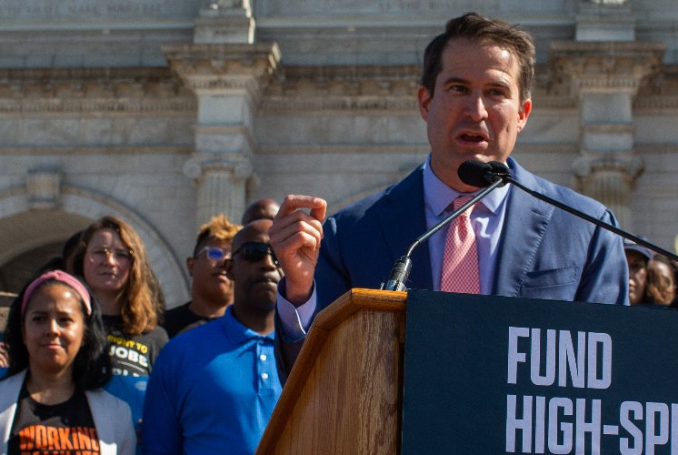 Democratic member of the US Congress, Seth Moulton, has announced that he will return donations received from AIPAC. (Photo: via Moulton X Page)
The litmus test for whether a politician is truly interested in representing the people who elect them to power is becoming their stance on Palestine, more specifically, Gaza.
As American public opinion continues to shift against Israel, the US political landscape is also undergoing a dramatic transformation. AIPAC, once viewed as an asset to aid in election races, is now becoming a liability, giving birth to a new generation of politicians who are demonstrating their sincerity through a refusal to be bought by the Israel Lobby.
While New York Mayoral candidate Zohran Mamdani has perhaps received the most attention for his pro-Palestinian stances, he is in no way alone. In fact, he is joined by countless others who use their anti-genocide stances as a means of connecting with their voter bases.
All authoritative polling data suggests the majority of Democratic Party supporters currently hold a more favorable view of the Palestinians than Israel. According to a recent Gallup poll, 92 percent of all Democrats said they oppose the war in Gaza. Yet, the ability of candidates to reject funding from the Israel Lobby and freely speak their mind on the issue transcends a simple agreement with constituents on a single foreign policy issue.
Instead, refusing to take AIPAC money is rapidly becoming a prerequisite in order to be viewed as authentic, and it drives belief amongst the public that any given candidate will actually work to achieve key campaign promises. In other words, AIPAC equals corruption, and being pro-Palestinian equates to authenticity.
One of the most successful campaigns, coming from this new generation of politicians, is that of Graham Platner, who is a Democrat running for a seat in the US Senate for Maine. In his campaign ads, he promotes a “Mainers First” mentality, centering the working class and also explicitly opposing Washington’s support for the genocide in Gaza. He has publicly rejected funds from AIPAC, as opposed to Senator Susan Collins, who seeks to unseat him and has taken at least $647,758 from the Israel Lobby.
Platner is a Marine Corps veteran who did four combat tours and also worked as an Oysterman. Despite countless attempts, from within the Democratic Party establishment and the Israel Lobby, to stir up controversies and undermine his campaign, the progressive candidate is still polling above his Democratic primary opponent and Maine Governor, Janet Mills.
Although the uptick in pro-Palestinian sentiment is more prominent amongst Democrats, there is also a notable shift amongst Republicans. Pew Research polling data shows that, while unfavorable views amongst Republicans overall stand at around 23 percent, amongst those aged 18-49, a whopping 50 percent said they viewed Israel unfavorably.
Harnessing the energy of the shift, the likes of Rep. Marjorie Taylor Greene, Rep. Thomas Massie, and Rep. Matt Gaetz have all explicitly come out in opposition to AIPAC. Their messaging around the issue is to assert that they are “America First”, as opposed to their Republican colleagues, whom they accuse of being “Israel First”. These representatives align themselves with popular conservative commentators like Candace Owens and Tucker Carlson, amongst others, who also carry the same rhetoric.
Ultimately, the idea of America First and slogans like Mainers First transcend partisan lines. The idea of prioritizing Americans above the interests of Israel has long been taboo, yet we saw this collapse during the Democratic primary campaign for the Mayor of New York.
When Zohran Mamdani was asked where he would first visit as Mayor, he answered calmly that “I would stay in New York City. My plans are to address New Yorkers across the five boroughs and focus on them.” Although he was then challenged repeatedly and asked to recognize Israel as a Jewish State, which he refused to do based upon opposition to systems of ethnic or religious hierarchy, the clip of his answer went viral, receiving broad agreement amongst both Democrats and Republicans.
Other politicians running for Congress, who are explicitly anti-AIPAC, include the following candidates:
Robb Ryerse for Arkansas’s Third District, who is seeking to unseat Steve Womack, funded to the tune of $142,030 by the Israel Lobby. In California, there is Chris Bennet running for the Sixth District, Mai Vang for the Seventh District, Saikat Chakrabarti for the Eleventh District, Chris Ahuja for the Thirty-Second District, as well as Angela Gonzales-Torres for the Thirty-Fourth District.
In Colorado, there is Melat Kiros for the First District, as well as John Padora for the Fourth District. Within Florida, there is also Bernard Taylor running for the Twenty-First District, Elijah Manley for the Twentieth District, Marialana Kinter for the Seventh District, and Oliver Larkin for the Twenty-Third District.
Running in Illinois, there is Robert Peters for the Second District, Junaid Ahmed for the Eighth District, Morgan Coghill for the Tenth District and Dylan Blaha for the Thirteenth District. Meanwhile, in Indiana, there is Jackson Franklin, who is running for Congressional District Five and, in Massachusetts, Jeromie Whalen is running for the First District.
Seeking to win Maryland’s Fourth District is Jakeya Johnson, while Donavan McKinney is running for Michigan’s Thirteenth District and Kyle Blomquist is competing for its First District. Crossing over to Missouri, there is a well-known progressive candidate, Cori Bush, for its First District and Hartzell Gray for Missouri’s Fourth District.
For New Hampshire’s First District, Heath Howard is in the running, while, in New Jersey, Katie Bansil is running for the Sixth District. Meanwhile, there is James Lally running for Nevada’s Third District, Aftyn Behn for Tennessee’s Seventh District and Zeefshan Hafeez for Texas’s Thirty-Third District.
Also contending for Washington’s Ninth District is Kshama Sawant, while Aaron Wojchiechowski is running for Wisconsin’s Fifth District and Brit Aguirre is contesting for West Virginia’s First District.
Meanwhile, Abdul El-Sayed is running for Senate in Michigan, and Karishma Manzur is a Senate Candidate in New Hampshire, both of whom reject AIPAC funding and oppose the ongoing genocide.
It is important to note that new projects, like AIPAC Tracker, are also now promoting candidates who refuse to take funding from the Israel Lobby and have set up a page whereby citizens can donate to these anti-AIPAC politicians. AIPAC Tracker has played a particularly important role in educating the public, through graphics, showing how much the Israel Lobby has given to individual politicians.
Despite the majority of the anti-AIPAC campaigns being led by progressive Democrats, it is clear that the infamy of the Israel Lobby is having a major impact on mainstream Democrats, too.
For example, earlier this month, AIPAC appeared to be experiencing an existential crisis following an announcement from prominent lawmaker, Seth Moulton, who declared he would not receive funds from the Lobby group and would even be returning their contributions.
In an official statement, Moulton claimed to be making his move due to AIPAC’s alignment with the Israeli government of Benjamin Netanyahu, in particular. For such a right-leaning Democrat, on foreign affairs, to be publicly disavowing AIPAC, it signaled the toxicity of its brand more than anything.
Back in 2024, AIPAC claimed victory after it managed to unseat progressive Democratic Party Representative, Jamaal Bowman, over his pro-Palestinian stances, in the “most expensive House primary ever” in US history. At the time, AIPAC had spent at least $14.5 million on anti-Bowman ads through its PAC, United Democracy Project, alone.
Just over a year later, it appears as if the Israel Lobby had forked out tens of millions for what can be labeled, in hindsight, as a pyrrhic victory. Although the Zionist Lobby groups have injected unprecedented funding into continuing their purchase of American elected officials, their strategy appears to be collapsing.
Over time, more and more Americans from across the aisle are beginning to correlate support for Israel with political corruption. The litmus test for whether a politician is truly interested in representing the people who elect them to power is becoming their stance on Palestine, more specifically, Gaza.
The more Israel interferes in American domestic affairs, demands free speech crackdowns, unconstitutional legislation, billions in taxpayer dollars to fund their wars of aggression, unlawful deportations of Israel critics and drags the US into more conflict overseas, the more the American opposition to the Israel Lobby grows.
Recently, Illinois-based journalist Matthew Eadie uncovered that AIPAC is now employing new tactics to get around its own toxic brand, by “driving donations without any transparency” through Unique ID campaigns.
One series of “AIPAC secret campaigns” has been in support of Minority Leader of the US House, Hakeem Jeffries, nicknamed “AIPAC Shakur” by popular radio-show host, ‘Charlamagne tha god’, whereby certain links to donate were shared and will not pop up as direct AIPAC contributions, yet are still traceable by the Israel Lobby and directed by them.
Social media activists are not letting these tactics slip and are actively pointing out what they claim to be deceptive tactics, only fuelling more anger at the Lobby, in general. Yet, such tactics appear to prove desperation on AIPAC’s behalf, especially amidst growing calls for them to register as a foreign agent.
(The Palestine Chronicle)

– Robert Inlakesh is a journalist, writer, and documentary filmmaker. He focuses on the Middle East, specializing in Palestine. He contributed this article to The Palestine Chronicle.

No comments:
Post a Comment